Unit 2: Civilizations of the Mediterranean World
Chapter 6: Greece’s Golden and Hellenistic Ages
Mon, Oct 14, 2013
13. Tue, Oct 15, 2013
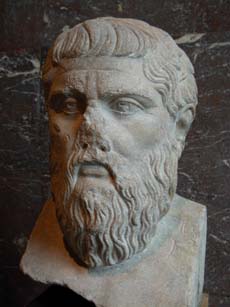
The Philosopher Plato. Paris, Musée du Louvre.
This chapter details the flowering of Hellenic (i.e., Greek) culture, and then the following spread of Hellenistic (i.e., "Greekish") culture under Alexander the Great and his successors. The two worlds are remarkably dissimilar in some ways. Hellenic culture is set up in view of the polis. It operated throughout the Greek-speaking world, but was always a matter of a few people, and it promoted independence of thought, especially at Athens. It was somewhat xenophobic: generally, from the Hellenic perspective, foreigners were barbarians. That was more or less what the term meant.
Alexander the Great attempted to take this Hellenic culture and globalize it. The result was a vast imperial state, somewhat like the Chinese empire we've just been looking at; it covered a huge area from Macedonia and Egypt east to India. Within that area, though Alexander imposed a modified form of Greek as a common, which became known as Koine (Common) Greek, the populations still had their own languages, cultural groups, and religious traditions at odd with one another.
Like the First Emperor of China, Alexander created something that barely outlived him. Upon his death, however, instead of passing whole to another dynasty, it fragmented into a handful of (still large, but considerably smaller) powers. They retained some of that common Hellenistic heritage and the widespread use of the Greek language, but they reverted to simpler, more autocratic forms of government. For Tuesday, we'll talk mostly about art and culture; for the Thursday session, we'll focus on the growth of the Macedonian empire and its results.
- The nature of Greek art and sculpture. What features characterize the stages of Greek art, and what does the art of the Greeks say about their view of humanity and reality?
- In 1929, Alfred North Whitehead, a prominent English philosopher, wrote in his Process and Reality,"The safest general characterization of the European philosophical tradition is that it consists of a series of footnotes to Plato". That's surely an exaggeration, but there is some respect in which it's true. What did Plato — and what did the Greeks generally — do that lay down this foundation for so much further thought? How was their way of thinking different?
- Greek drama from the Golden Age is generally considered the foundation of the western dramatic tradition as well. What we have surviving from that tradition is a remarkably small corpus of material. It also needs to be pointed out that all we have surviving is from a single city — namely, Athens. We know that there were theaters in other poleis, but it was Athenian tragedy and comedy that loomed largest. The information provided by the book on tragedy is very largely wrong: the definition of hubris,in particular, while consistent with modern usage of the term, has nothing to do with what the Greeks thought it was about. Those who have taken Western Literature to Dante have probably heard this before. The book's discussion of what makes up tragedy and comedy is similarly the kind of thing that arises from the reading of one surviving Greek tragedy and one comedy, rather than thoughtfully examining the range of surviving dramas. Tragedies do not all end badly for the principal characters; comedies really are not comedies primarily because the principals solved their problems. Finally, there are two major kinds of Greek comedy, which are tied up with the political history of the period. Distinguishing Old Comedy from New Comedy is very significant. We'll talk about this somewhat.
Contents of this page © Copyright 2011, 2012 by Paul Christiansen and Bruce A. McMenomy.
Permission to download or print this page is hereby given to members of Scholars Online for purposes of personal study only. All other use constitutes a violation of copyright.