Week 2: The Archaeology of Ancient Writings, and Plato in Particular
How these works reach us

Most people have at least a vague notion that ancient writings reach us through old manuscripts, but from that point their understanding wanes quickly. What is probably not as well appreciated is that most of the manuscripts, while old, are nowhere near as old as the original texts they are relaying. To take just our present example, the best (and one of the oldest) manuscripts of Plato is the so-called Clarke Plato, now in the possession of the Bodleian Library in Oxford. We’ll talk about this a little later, though you can look at a few pages of it on the Digital Bodleian site here. The thing to note about it here, however, is that it was made long after Plato’s time. Unlike most old manuscripts, it can be dated very precisely — in fact, we know who wrote it, when, and for whom. It was written by John the Calligrapher in Byzantium for Arethas the Deacon in A.D. 895. It contains the six so-called tetralogies — collections of four dialogues each — that make up the core twenty-four Platonic dialogues. The first of these tetralogies contains the Euthyphro.
Though this is, as noted, one of the oldest and most reliable of the manuscripts supporting the text of Plato, a little math will tell you that it was written more than twelve centuries after Plato’s time. What bridges those intervening twelve hundred years? What connects this manuscript to what Plato originally wrote, and how can we be sure that we really have anything much like Plato’s original?
Plato's original text
At the beginning of the process, of course, the author writes a work. The work is “published” — which doesn’t mean that it’s sent to a printing press for mass distribution, but merely that it’s released for others to read and perhaps to copy. This is what we’re trying to discover and understand when we read the work. The trick is that it doesn’t reach us directly, but through the lengthy unfolding of what we call textual transmission.
Plato’s dialogues all appear to have been very carefully worked pieces, involving a lot of subtle consideration and careful rewriting of passages. To all evidence, they were designed to be published and read widely: they are what we call exoteric. They are public-facing products. In this respect they differ from the works of Aristotle, which were considered esoteric: that is, they were written mostly for Aristotle himself and for those who worked under him as lecturers. Aristotle apparently wrote some dialogues like those of his teacher Plato, but none of them, unfortunately, survives.
The book as Plato knew it was not much like the books we have: the modern form of the book is what is known as the codex which specifically refers to a book made up of pages bound together at a spine. Plato’s book would have been a roll or scroll — typically written on papyrus, which is a kind of paper made from the matted fibers of the stem of the papyrus plant. Later books were more commonly written on parchment, which is animal skin (often sheepskin) tanned and whitened and specially prepared for writing. All these materials were, from our point of view, very costly. You can buy a ream — five hundred sheets — of clean white paper for under five dollars. A single leaf of parchment represented a sheep. Five hundred of them would have, in terms of today’s buying power, have been worth several thousand dollars, even before someone got to work writing on it.
Textual transmission
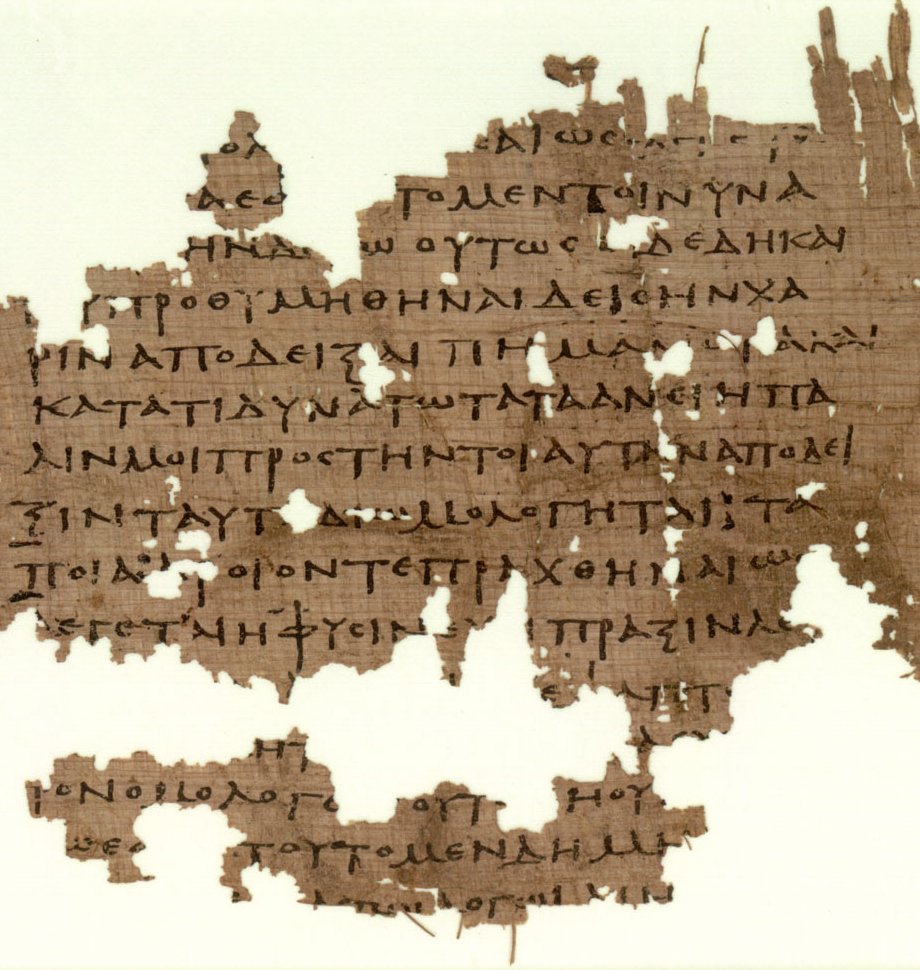
Textual transmission is a complicated business, and there are a lot of technical matters that can pop up, but the following description should at least provide an outline for how we use manuscripts to ascertain the original texts — and how, in fact, the edited versions produced by the leading classical presses like Oxford and Cambridge Universities in England, or Teubner in Germany, can be better — more faithful to the original text as written — than any of the surviving manuscripts. It’s not black magic: it’s a matter of something like genetic inheritance.
It is very rare that the original manuscript — what we call the autograph — survives. We have autographs of some late medieval works. Certainly we have nothing in Plato’s hand, however, nor do we have autographs of any of the other Greek or Latin works of the classical era. We have a few copies of the Aeneid going back to the late fourth century, but even that is a good long time after Vergil wrote. For the most part, we have to assume that the original work was copied, maybe once or maybe more times — and that those copies were themselves copied (again, once or more times), and so on. Eventually, in the chain or tree (metaphorically speaking of the branching descent, much like a family tree) of copies, we arrive at the ones that actually do survive and are known.
A few ground-level facts need to be appreciated. First, these copies are all made by hand, one at a time. The amount of time to produce these copies typically made books of any sort very expensive. Imagine what your copy of the Euthyphro or the Bible would be worth, just in terms of labor, if it had not been run off a printing press with tens of thousands of other identical copies, but painstakingly written out by hand, one at a time. A Bible, for example, was about a year’s worth of work for a skilled professional scribe. In today’s terms, your Bible would cost something like a middle-management salary for a year. It’s no wonder that not everyone had a copy for himself.
Textual editing and recension
The frustrating fact about hand copying is that it’s virtually impossible to produce a text without introducing at least a few errors. If you’re a very capable scribe, you may get away making fairly few. If you’re just average, you will probably introduce quite a number. Accordingly this process systematically corrupts — modifies and creates differences in — not only the copy that you’re producing, but every other copy that will be made from it after that. This is the critical secret. It accounts for the fact that all the surviving manuscripts are at least somewhat different from one another, of course — but it also provides the information we need to unravel the puzzle as well — for by comparing the surviving manuscripts systematically, we can cluster them into groups that share a common ancestry, and use that information to figure out which errors came into the descent at what points. And if you know when an error entered the manuscript tradition, you can reverse it while getting back to the common ancestor.
A great deal more goes into the management of stemmatic recension of a manuscript, and we don’t have time to go into it here. But at its most basic, it is a powerful tool that will help us arrive at something close to the words that the author left, and of which subsequent copyists made a bit of a mess — structured in its way, but still a mess. In broadest terms, we talk about that process as one of textual criticism. Unlike some other critical approaches (like the so-called “higher criticism” of Biblical texts, sometimes referred to as “source criticism”, which relies on the wholly untested and unverifiable documentary hypothesis), textual criticism — plodding detail-oriented work as it may be — has over the years produced both some notable successes and occasionally has predicted what a reading ought to be before it turns up in another manuscript that had previously been overlooked.
Translation
It should be pointed out — since the confusion often arises — that this is all still about nailing down what the words of the original text were in its own language. It has nothing to do with translation, which is a different art and has its own set of problems. Most of our translations are based on such critical texts as the kind outlined above.
Translation is always imperfect, and there is no way even to say what a perfect translation of anything would look like. It is naive to think that there is anything that can be called a literal or word-for-word translation. The phenomenon does not exist and cannot exist. No two languages — even closely related ones — work the same way. Words have multiple meanings or gradations of meaning in all languages, but the range meanings of a given word in the source language virtually never corresponds with the entire range of meanings in the language into which we are trying to translate. Accordingly the translator has to make decisions about what implications of a word or a phrase should be jettisoned in order to retain others.
Hence there is no real logical endpoint to the translating process. Particularly excellent translations may be considered definitive in their time, but that’s always a provisional status. Sooner or later the most robust of translations will probably need to be replaced, if only because the meaning of the target language has shifted in some subtle or some not-so-subtle ways. Benjamin Jowett translated much of the Platonic corpus while working at Balliol College in Oxford during the nineteenth century, and his renditions formed a kind of standard for much of the first part of the twentieth century. Indeed, they are still read today. But we do not today speak the English of the nineteenth century. I’ve linked his version of the Euthyphro to the “Extras” page. You can compare it to the version you have. I think you’ll find it illuminating.
The Platonic corpus

Most of the philosophical works of Plato are in the form of dialogues — conversations between Socrates and various other interlocutors. The constant in almost all of them is Socrates. This fact raises a secondary problem, since, while Plato knew Socrates late in his life, some of the dialogues are set in Socrates’ youth, at a time before Plato ever knew him — some even before Plato was born. We will take up the question of their authenticity later on when we discuss the so-called “Socratic problem”.
Thirty-five dialogues are traditionally attributed to Plato, along with thirteen letters. Not all of these are thought to be authentically Plato, as well, though scholarly opinion differs on which ones are genuine and which ones are spurious. The works are clustered into nine tetralogies (sets of four) of very different lengths. You can find these catalogued in the Wikipedia article here. If you know the narrative line of the Platonic dialogues, you will note that the first tetralogy all deals with the very end of Socrates’ life — the Euthyphro, the first, precedes his trial by a day or two, while the Apology is his defense speech; the Crito and the Phaedo deal with his imprisonment after his conviction and his death.
You will probably have noted already that we typically refer to passages in Plato by Stephanus numbers. These are just the pages of an early edition of Plato published in 1578 by Henri Estienne — Henricus Stephanus in Latin. As you can see in the picture (it’s probably best if you can open the image in a new tab so you can zoom in on it), the page has the Greek text, surrounded by a Latin translation and a cluster of notes. The Greek block in each page is divided into sections A-E. The last section (usually E) tends to vary in length, because the Latin translation and the notes take more room on some pages than on others. Some pages, like those shown here, don’t even make it to E. But this allows us to refer to specific sentences and locate texts very precisely, much like the chapter and verse method contrived in the Middle Ages for citations from the Bible. These citation numbers have been preserved in most of the more recent editions of the Greek text, and are even retained (as well as they can be) in translations, though the Latin version and the notes have long passed out of widespread consideration. The line numbers that often follow the page and letter are taken from John Burnet’s Oxford Classical Text editions from 1900-1907.
The Stephanus volume of the first tetralogy is available as a downloadable PDF (in a good photo-reproduction). It’s linked on the “Extras” page.
Parallel: Biblical studies
The issues of textual criticism range far more widely, of course, than Plato, and certainly those who believe in the validity of any kind of scriptural revelation will also necessarily find those questions of compelling interest too. If you have an interest in these questions, talk to one of us about it, and we can point you toward more resources — there’s more out there than you might suppose.
For discussion:
How certain can we be that we'’e reading the words and ideas of the original Socrates? The original Plato? There are some differences of opinion here, but we can discuss them in class.
If you’re reading along in Greek, cover 4b7-6a5.
Contents of this page © Copyright 2021 by Karl F. Oles and Bruce A. McMenomy.
Permission to print or reproduce this page is hereby given to members of Scholars Online for purposes of personal study only. All other use constitutes a violation of copyright.