Physics
Chapter 20: 1-4

Web Lecture
Ampere's Law
Introduction
The experimental investigation by which Ampere established the law of the mechanical action between electric currents is one of the most brilliant achievements in science. The whole theory and experiment, seems as if it had leaped, full grown and full armed, from the brain of the 'Newton of Electricity'. It is perfect in form, and unassailable in accuracy, and it is summed up in a formula from which all the phenomena may be deduced, and which must always remain the cardinal formula of electro-dynamics.
— James Clerk Maxwell, A Treatise on Electricity and Magnetism (1873), Vol. 2, 162.
Outline
Ampere's Law: Magnetism around Current
Not only do moving charges give rise to magnetic fields, they also respond to external magnetic fields by changing direction.
Electrical Charges and External Magnetic Fields
When current flows through a wire, it really is just a lot of electrical charges in motion. If charge q moves through a wire of length l in time t, we can define this rate of motion either in terms of the velocity of the charge, or in terms of current i:
Ampere discovered that two wires with current flowing in the same direction will exert a mutually attractive force:
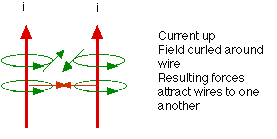
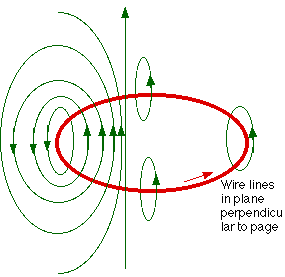
In a loop of wire, the field lines bend around the wire, reinforcing the field in the center.
If we have a loop of wire, the field gets more complicated (the force is not represented in this diagram):
The Magnitude of Magnetic Force
The strength of the force exerted depends on the current in the wire and the length of the wire is our old friend the vector cross product, or where θ is the angle between l (the length of the wire) and B. Note that when l and B are parallel, there is no force on the wire from the magnetic field.
If we have a particle moving with velocity v, then the force is
The two forms, then, are equivalent:
We use the first form to describe the resulting force acting on free charges moving in space through an external magnetic field, and the second to describe an external magnetic force acting on current-bearing wires.
All practical applications of electromagnetic fields — motors, generators, and anything that detects intensity or changes in either field — depend on this relationship.
Practice with the Concepts
Discussion Points
- Suppose that you have three iron rods, two of which are magnetized but the third is not. How can you determine which two are magnets without using any additional objects?
- Two insulated long wires carrying equal currents I cross at right angles to each other. Describe the magnetic force one exerts on the other.
© 2005 - 2026 This course is offered through Scholars Online, a non-profit organization supporting classical Christian education through online courses. Permission to copy course content (lessons and labs) for personal study is granted to students currently or formerly enrolled in the course through Scholars Online. Reproduction for any other purpose, without the express written consent of the author, is prohibited.