
Physics
Chapter 20: 1-4

Web Lecture
Magnetic Fields
Introduction
Since the discovery of secret things and in the investigation of hidden causes, stronger reasons are obtained from sure experiments and demonstrated arguments than from probable conjectures and the opinions of philosophical speculators of the common sort; therefore to the end that the noble substance of that great loadstone, our common mother (the earth), still quite unknown, and also the forces extraordinary and exalted of this globe may the better be understood, we have decided first to begin with the common stony and ferruginous matter, and magnetic bodies, and the parts of the earth that we may handle and may perceive with the senses; then to proceed with plain magnetic experiments, and to penetrate to the inner parts of the earth.
— William Gilbert, On the Loadstone and Magnetic Bodies and on the Great Magnet the Earth: A New Physiology, Demonstrated with many Arguments and Experiments (1600)
Outline
Fields and Forces
We now look at magnetic fields -- another force, another field. As with gravitational and electrical fields, density or "flow" of the magnetic phenomena is greatest near the source, and diminishes as the square of the distance from the source. But magnetic fields are closely related to electrical fields -- so we can't look at them in isolation.
A Comparison of Forces and Fields
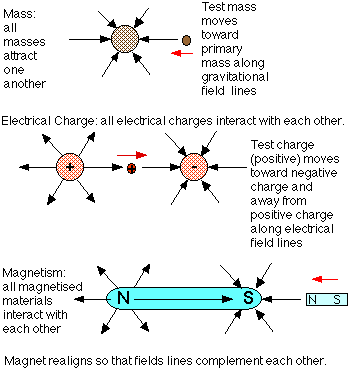
Magnetism, like charge and mass, appears to be a property of matter. Like charge, it is characteristic of some kinds of matter and not of others (at least, not detectably). Unlike charge, magnetic fields aways have a positive (north) and a negative (south) pole. Note the similarities and differences between the three types of fields in the following diagram. Each property of matter gives rise to a field. Objects subject to the field experience a force along the field lines.
- Gravitational forces are always attractive for any kind of matter. Gravitational field lines begin on one mass and end on another mass; if no second mass is available, the lines will extend into space. Line direction is always "positive" toward the mass.
- Electrical forces are either attractive or repulsive, depending on whether the particles involved have different types of charge or the same type of charge. Electrical field lines may begin on a charged particle or end on a charged particle; but they do not begin and end on the same particle; if no other charged particle is available, they extend into space. Line direction depends on type of charge: for positive charges, line direction points away from the charged; for negative charges, line direction points toward the charged particle, indicating the direction in which a positive test charge will move if placed in the field.
- A magnet always exerts both attractive and repulsive forces on any other magnet; the dominant force depends on the orientation of the magnets to each other. Magnetic field lines will begin and end on the same particle (they are continuous) if no other magnetized materials are near.

Electricity and Magnetism
The interaction of electricity and magnetism rests on the movement of charge. Magnetic force fields arise ONLY when charges are moving, and any motion will generate the magnetic field: spinning in place is moving. The direction of the magnetic field and force vectors are at right angles to each other and to the direction of the velocity vector of the moving charged object.
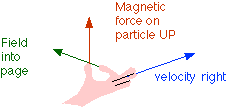
A moving electrical charge gives rise to a magnetic field. The direction of the magnetic field and the force exerted by the field are both at right angles to the velocity of the moving charge and to each other. That means the three vectors describe three different directions, like the x-y-z coordinates of a three-dimensional coordinate system. But where x, y, and z usually are given as y up, x to the right, and z out of the page, v, B, and Fm are oriented somewhat differently:

In order to remember this relationship, physicists use the right hand rule. If the fingers of the right hand point in the direction of the velocity and then curl in the direction of the field, the thumb points in the direction of the resulting force. [The diagram below is the same as the diagram above, it has just been rotated 180° along the velocity axis].
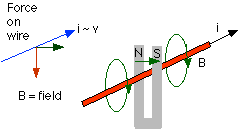
The resulting magnetic field circles the wire, and the resulting force pulls out on the wire in all directions. If a magnet is placed near the wire, its magnetic field will exert a force on the wire which depends on the direction of the current in the wire (field direction is green arrow, force direction is orange arrow, velocity of moving (positive) charge is blue arrow or current direction:
Practice with the Concepts
Discussion Points
- Describe the magnetic field lines surrounding a straight wire carrying a current that is moving directly away from you. What direction do they point?
- If a negatively charged particle enters a region of uniform magnetic field which is perpendicular to the particle's velocity, will the kinetic energy of the particle increase, decrease, or stay the same?
© 2005 - 2026 This course is offered through Scholars Online, a non-profit organization supporting classical Christian education through online courses. Permission to copy course content (lessons and labs) for personal study is granted to students currently or formerly enrolled in the course through Scholars Online. Reproduction for any other purpose, without the express written consent of the author, is prohibited.