Physics
Chapter 16: 7-12

Web Lecture
Electrical Fields
Introduction
If I take a glass rod, and rub it with a piece of silk covered with what we cal amalgam, look at the attraction which it has; how it draws the [India rubber] ball toward it; and then, as before, by quietly rubbing it through the hand, the attraction will be all removed again, to come back by friction with this silk.
— Michael Faraday, Lecture V on The Forces of Matter, delivered as part of a series of Lectures suitable for a Juvenile Auditory, a kind of Mr. Wizard demonstration for children which Faraday started giving at Christmast time in 1830 at the Royal Institute, and which has continued annually ever since, interrupted only in 1941-42 when London was being bombed.
Outline
Now we turn to application of these concepts and laws.
Practice with the Concepts
Recall that in the earth's gravitational pull is often expressed in terms of the acceleration a test mass experiences in the gravitational field:
We can think of this gravitational acceleration as gravitational potential.
We can create an analogous situation with electrical fields. The "field" E is a measure of the magnitude of the electrical force put out by Q:
The electrical potential E, measured in volts, is:
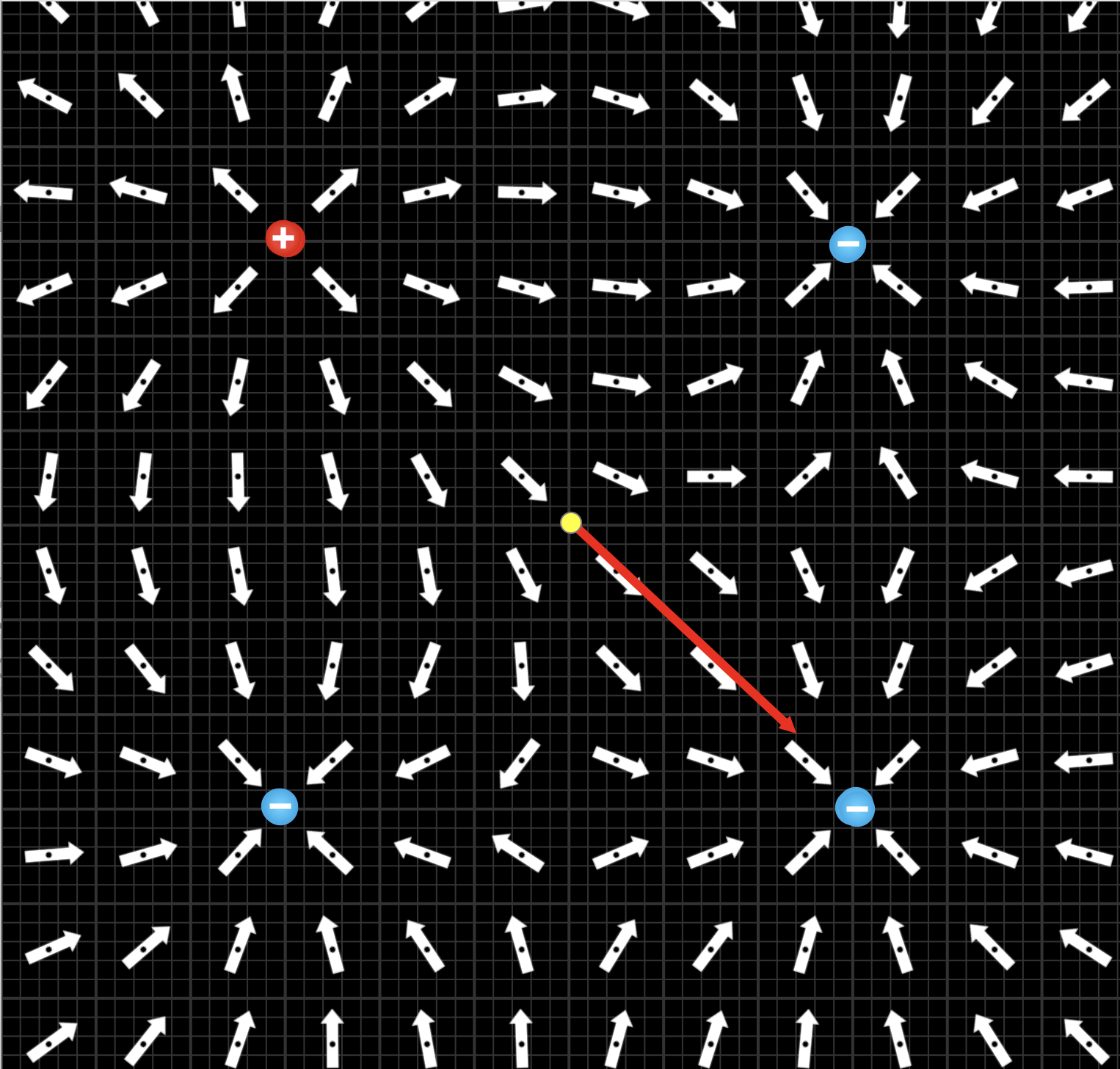
We can use this relationship in complex charge situations to determine the magnitude of the electrical field at points between charges. Consider this situation: We have a square 60 cm on a side. One corner has a +45 µC (microCoulomb) charge and the other three have -31.0 µC charges. We want the magnitude of the field at the center of the square.
| We are given the following information: |
Charges Q1, Q2, and Q3 are -31.0 µC. Charge Q4 is +45 µC. Distance r is 60cm between charges on adjacent corners |
| What do we want to find out? | The field at the center of the square. |
| Analyze the situation: | The contributions from the two -31.0 µC charges at opposite corners cancel at the center. We need only consider the remaining two charges, which point in the same direction (away from the 45µC charge) because of the opposite sign of these charges.
The two charges are equidistant from the center. The resulting field will be the sum of the two individual fields generated by the two charges. |
| We can use the electrical field law: | |
| What do we need to determine still? | From trig or geometry, r between the corner and the center of the square is 0.60cm * sqrt(2)/2 |
| Try to complete the setup and calculation. Be prepared to defend your answer in chat. | |
We can represent electrical fields graphically by drawing lines which map the amount of force that will be exerted on the test charge q by some charge Q. By convention, these lines of force point out from positive charges and into negative charges. More lines indicate a greater density of charge. If we have two charges in proximity, the lines of force will bend as the fields interfere with each other.
Discussion Points
- The form of Coulomb's law is very similar to that for Newton's law of universal gravitation. What are the differences between these two laws? Compare gravitational mass and electric charge.
- When determining an electric field, must we use a positive charge, or would a negative one do as well?
- Why can electric field lines never cross?
© 2005 - 2026 This course is offered through Scholars Online, a non-profit organization supporting classical Christian education through online courses. Permission to copy course content (lessons and labs) for personal study is granted to students currently or formerly enrolled in the course through Scholars Online. Reproduction for any other purpose, without the express written consent of the author, is prohibited.