Physics
Chapter 12: All

Web Lecture
Sound
Introduction
Excessive noises, we know, shatter the solid bodies even of inanimate things: the noise of thunder, for instance, splits rocks and the strongest of bodies. But if the moving bodies are so great, and the sound which penetrates to us is proportionate to their size, that sound must needs reach us in an intensity many times that of thunder, and the force of its action must be immense. Indeed the reason why we do not hear, and show in our bodies none of the effects of violent force, is easily given: it is that there is no noise.
— Aristotle, De Caelo II, 9
(On why there is no "music of the spheres", as the Pythagoreans claim)
Outline
Sound
We turn now from general considerations of waves to a practical one: longitudinal sound waves. Later on in the course, we will look at transverse wave phenomena when we study the interaction of the electrical and magnetic fields that product light.
Speed, Pitch, and Loudness (Intensity)
We have already discussed many characteristics of wave motion; now we apply them to sound. Sound is composed of compression waves (or rarefaction waves, if you want to consider the areas of expansion): it is a longitudinal wave in which the molecules of the medium bunch up and separate as the energy wave passes through them. Like any other wave form, sound has certain characteristics.
The speed of the wave is proportional to the density and the bulk modulus (which measures the compressibility of the medium carrying the wave): v = √(β/ρ). Note that the velocity is independent of pressure, or of the frequency of the wave. The velocity of sound in gases is a function of temperature, however, because temperature affects the overall density of the gas. For air, velocity can be estimated using the equation v = 331.5 + 0.607T where T is measured in degrees centigrade; your text gives another approximation (331 + 0.6T); which one you use depends on the level of accuracy required.
Pitch is the human perception of particular frequencies of sound. We sense high frequency-short wavelength sound has a high pitch, and low frequency-long wavelength sounds as low pitches. The range of human hearing runs from 20 cycles per second or Hertz to 20 000 Hz. Frequencies below 20Hz are infrasonic; frequencies above 20 000 Hz are ultrasonic. The term supersonic relates to speed of sound, not its pitch; something traveling with ultrasonic speeds is moving faster than the speed of sound in that medium.
Another aspect of sound is its loudness or intensity. Since intensity depends on amplitude, which in turn is a measure of the power (energy per second) transmitted through a given area. Recall that area affected by the wave increases as the sound wave moves out from its source, so the loudness of the wave fades with distance. Intensity is therefore a function of A2/r2.
Intensity is measured as watts/meter2 (reflecting the fact that amplitude is power/area). More commonly, we use the logarithmic scale, and compare all sound to the minimal level of human hearing: I0 = 1.0 * 10>-12 watts/meter2.
| LOG refresher: If y = 10 >x, then x = log10 y. In other words, if y is the result when 10 is raised to the exponent x, then the log of y with respect to base 10 is the exponent x. Log scales allow us to compress information and represent exponential relationships as linear relationships. |
Standing Waves and Harmonics
One of the most important practical considerations is the function of sound as music. If we have a string or tube into which we are continually adding a disturbance, the string or the column of air inside the tube will vibrate. The energy does not travel along a standing wave (it travels as the antinode, which isn't moving pas the nodes in a standing wave), but it can be used to cause the air around the string or the sounding box or outside of the tube to vibrate.
Standing wavies will only occur, however, if the wave reflected back along the string or tube reinforces the incoming wave. The fundamental wavelength (or frequency) is the longest wave which can be reflected completely.
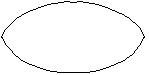
| For strings, both ends must be fixed in order to achieve a standing wave, so the fundamental wavelength is twice the length of the string: one antinode with two nodes.
A point on the vibrating string moves up and down, so the string wave has amplitude which can be measured by observing the displacement of the string. |
|
where l is the length of the string. |
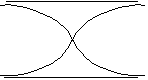
| In an open tube, the maximum displacement must occur near the ends of the tube. So the fundamental wavelength is also 1/2 the tube distance, but the node is in the center of the tube. |
|
where L is the length of the tube |
| In a closed tube (one open, one closed end), the fundamental wavelength must be 1/4 the length of the tube. Air molecules in the tube move back and forth horizontally <-->. |

|
where L is the length of the tube |
The overtones or harmonics associated with a given frequency occur when more waves can be packed in the tube or onto the string in the same format as the fundamental wavelength. The second harmonic of a string or open tube has two antinodes, so one complete wave, which means the second harmonic has a wavelength λ = L or the length of the string or open tube. On the other hand, the second harmonic for a closed tube has to have an open end and a closed end, so it has 3/4 of a complete wave. In this case, L = 3/4λ. Notice that closed tube lengths are always an odd multiple of 1/4 of the wavelength involved, since that is the minimal distance between the open part of the wave (the antinode) and the closed part of the wave (the node). Be sure to study the diagrams in the text on this topic.
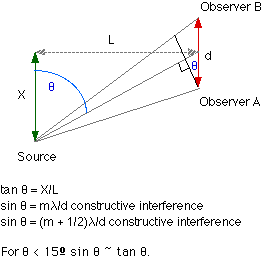
The unique characteristic of a particular wave pattern gives sound its quality and allows the human ear to distinguish the source of the sound. We have already looked at superposition of waves, the adding up of different vibrations which contribute to the overall wave pattern. Now we look a little more closely at the interference which occurs when two waves reach different targets.
The relationships diagrammed above allow us to determine whether a given observer will experience constructive or destructive interference.
Doppler
Another set of considerations comes into play if either the source of the wave (light or sound) or the observer is moving. The relative motion toward or away from each other causes the observer to perceive a shift in the frequency. The general equation for the Doppler shift is: where f0 is the actual frequency emitted and f is the observed frequency. If the observer and source are moving toward one another, than the topmost of the + or - signs hold; if the observer and source are moving apart, then the bottommost set of signs holds. Notice that this means that f > f0 if the distance between the two is decreasing, but f < f0 if the distance is increasing [Refresh screen to force animation to run again.]
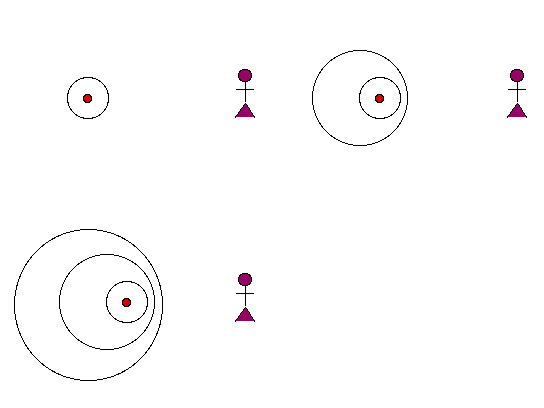
An observer to the left sees the wavelengths get longer as the source of sound moves to the right; the observer at the right sees the wavelengths get shorter.
Practice with the Concepts
Discussion Points
- What is the evidence that sound travels as a wave? That it is a form of energy?
- If a wind is blowing, will this alter the frequency of the sound heard by a person a rest with respect o the source? Is the wavelength or velocity changed?
© 2005 - 2026 This course is offered through Scholars Online, a non-profit organization supporting classical Christian education through online courses. Permission to copy course content (lessons and labs) for personal study is granted to students currently or formerly enrolled in the course through Scholars Online. Reproduction for any other purpose, without the express written consent of the author, is prohibited.