
Physics
Chapter 6: Sections 5-7

Web Lecture
Conservative and Non-Conservative Forces
Introduction
L'intégral ∫Pds, dont chaque élément Pds est le produit de la composante tangentielle d'une force F ar l'ar infiniment petit ds décrit par son point d'application, se nomme la quantité de travail dû à cette Force F. Le produit Pds is l'élément dâ á cette mème force.
The integral ∫Pds, where every element Pds is the product of the component of force F tangential to each infinitely small arc ds described by its point of application, is named the "quantity of work" due to this force F. The product Pds is the element of work done by this same force.
Gaspard-Gustave de Coriolis - Du Calcul de l'Effet des Machines
Outline
Conservation of Energy
Setting the terms straight:
A system is any set of objects we define by describing a boundary around them. Anything outside the system belongs to th system's environment. A system can be
- open if both matter and energy can cross the boundary (an open jar or bowl, into which light falls and into which we put objects).
- closed if only energy can cross the boundary (a glass jar with its lid on, so that only light can enter it)
- isolated if neither energy or matter can cross the boundary ( closed thermos with a silver-lined chamber.
Conservative forces and the conservation of energy
So far, we've defined work done as the change in kinetic energy.
We now look at a special kind of change: the state change. A state change depends only on the original and final states. How the system got from one state to another is irrelevant. State changes always involve differences and do not necessarily depend on an absolute measurement. For example, if you don't keep track of how you spend your money, you may only notice that you had $5 at the start of the day and now have on $1, so you must have spent $4 even if you don't remember where it went.
Potential energy is an example of a quantity that undergoes state changes. The potential energy of the object depends only on the object's current relationship to something that exerts a force field, like another mass exerting gravitational attraction or another charged particle exerting electrical attraction or repulsion. The amount of force exerted on the object depends on the distance of the object from the source, and is theoretically infinite when the distance is zero and theoretically zero at infinity -- neither state being practically achievable.
One way to measure potential energy is to realize that it is the work we need to do to move something under the influence of a force field from one place to another in the field. We call this work conservative, and say that
ΔPE = - Wcons
That is, an increase potential energy represents the amount of work we had to put into the system to make the move.
When the only force operating on the object comes from fields like gravitation and electricity, then the net change inenergy is equal to the difference in initial and final state. It does not depend on how we moved the object, or the path it took. But if the forces involved can be increased or decreased, by changing the path through which the object moves to change states, than at least some of the forces are non-conservative, and some work is done which cannot be accounted for by a change simply in potential energy .
The net work, (we whe have defined as causing a change in kinetic energy), is the sum of both the work done by all forces on an object, so it must include work done by both conservative and non-conservative forces.
The work-energy principle becomes
Wnet = ΔKE = Wcons + Wnonc
Wnonc =Wnet - Wcons = ΔKE + ΔPE
This makes sense: the net work done inside an isolated system by some objects on other objects in the system is equal to the sum of the work done by both conservative and non-conservative forces and ALSO, separately, equal to the total change in both forms of energy.
Conservation of mechanical energy
If all the non-conservative forces are zero, then the change in potential energy of a system can be accounted for by the change in kinetic energy:
ΔPE = ΔKE.
The total mechanical energy of such a system is always conserved: E = PE + KE = PE + ½m * v2. For a falling body in a medium where we can neglect frictional resistance, this is easy to see:
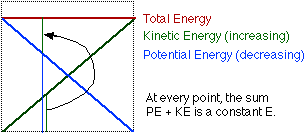
This principle buys us a major tool in analyzing situations where only conservative forces, such as grativity, are working. We can equate any two points in the career of a falling body thusly:
PE1 + ½m * v1 = PE2 + ½m * v2
Now we can revisit our earlier analysis of bodies under force. Study the examples in the text carefully. Where before we could not solve problems involving changing acceleration (without recourse to calculus), now we can analyze them in terms of energy changes. Pay particular attention to example 6-12, where the second solution shows you all the math you can avoid by solving for the quantity desired before substituting in numerical values.
The Conservation of Energy
Let's revisit the concept of potential energy a bit. The potential energy of any system is a result of its position in a force field. Gravitational forces arise arise from a mass point, electrical forces from a charge point. At the source of the field, potential energy is infinite. At an infinite distance from the source, potential energy is zero.
Normally, we determine potential energy as a change in position from some initial point: ΔPEAB = the difference in potential energy as anobject moves from point A to point B. The kinetic energy equivalent is then the work done by the system on the object (if potential energy increases) or by the object on the system (if the potential energy decreases). If work increases the potential energy and the conversion is 100% efficient, as is the case when there are only conservative forces involved, no energy is wasted, and all the work energy is stored in the new state of the system. This is what happens when we move a box higher against a gravitation field, or move two atoms closer together against their repulsive electron fields until they react and form a molecule. The energy we put in is useful energy, and we can get it back out again and do work with it.
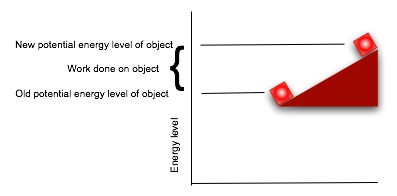
Suppose we isolate a system of objects. Neither energy or matter can cross the boundaries of the system. Since energy cannot be created or destroyed, we can express the conversion of energy from one form to another by conservative forces as a conservation rule: for any isolated system, ΔE = 0. If the conversion process is 100% efficient (the result of only conservative forces operating), all of the energy in the original form appears in the final form. This means the energy level within the isolated system can't change; energy is conserved. Energy can change form, from potential energy due to position in a gravitational field to kinetic energy of movement or back, but not amount.
Practice with the Concepts
Discussion Points
- Can a "superball" ever rebound to a height greater than the one from which it was dropped?
- You lift a suitcase up onto a table. Does the work you do on the suitcase depend on
- whether you lift it straight up or use a complicated path?
- how long it takes?
- the height of the table?
- the weight of the suitcase?
- How does the power you exert change with the factors in the previous questionn?
© 2005 - 2026 This course is offered through Scholars Online, a non-profit organization supporting classical Christian education through online courses. Permission to copy course content (lessons and labs) for personal study is granted to students currently or formerly enrolled in the course through Scholars Online. Reproduction for any other purpose, without the express written consent of the author, is prohibited.