Physics
Chapter 6: Sections 1-3

Web Lecture
Work and Energy
Introduction
So far, we've spent our time on the basic characteristics of motion: distance, time, velocity, acceleration, and their relationship with one another and the force that gives rise to acceleration. We've talked about the specific force that arises from mass: gravity, and the way a constance acceleration toward a point (the center) can create uniform circular motion.
Now we start on a new concept: energy. We never observe energy directly; we can only observe its effects in the motion a moving object has (kinetic energy), or the amount of work we must do to move an object held in a force field (potential energy). But since energy also has relationships with force and velocity, we will be able to use what we already know to analyze energy in a given situation.
Historical notes
While the concept of force dates back to the Greeks, the concept of energy is relatively new. It grew out of Leibniz' idea that conservation of some kind occured when forces were applied. He identified this conserved quantity as vis viva, the product of mass * the square of velocity (mv2), and assumed that it was an innate property of matter. At the same time, Newton and Descartes proposed that momentum (mv) was conserved, but that external force was required for a body to change its state of motion. This gave rise to the vis viva controversy, in which intellectual luminaries like Madame Émilie du Châtelet and Voltaire took sides. The vis viva school described force over distance: FΔd = mviinitial2 - mvfinal2
while the Newtonian faction described the effects of force over time: FΔt = mvinitial - mvfinal
In the late eighteenth century, Lavoisier and Laplace considered the possible relationship between vis viva and caloric, a fluid identified as heat, and Count Rumford noted that boring holes in cannons (mechanical work) generated heat. Practical engineers pointed out that both momentum and vis viva were necessary to completely analyze many systems, and that under many conditions, even when it was not conserved, a more useful definition of vis viva as energy, ½mv2, allowed them to find an exact value in converting work to kinetic energy. In one of the most famous experiments during a century of famous experiments, James Prescott Joule showed that the gravitational potential energy consumed by a falling body created a corresponding temperature increase in a waterbath, and thus gave us a conversion factor for heat and mechanical energy.
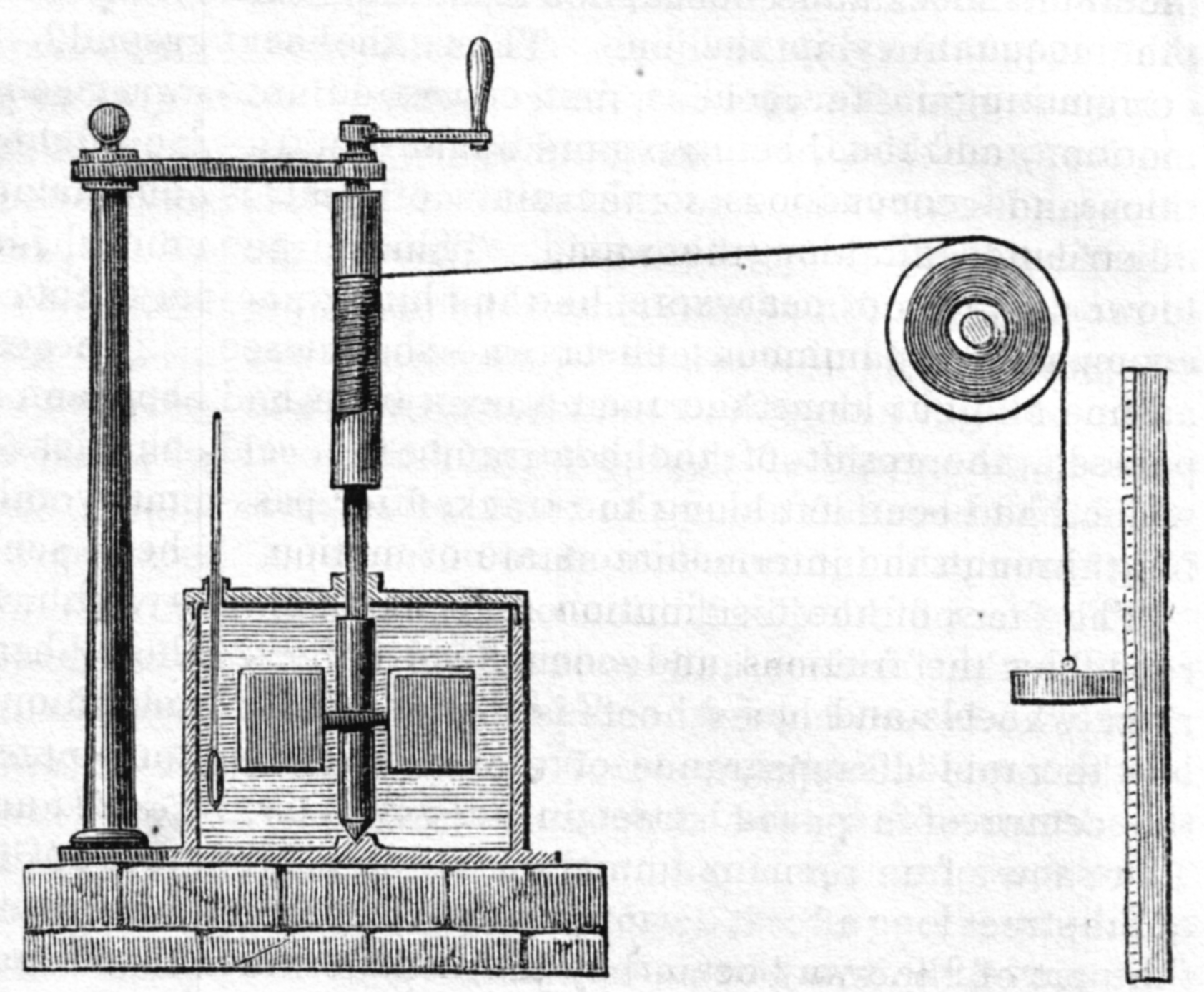
Joule's aparratus. The falling weight turns the paddles, stirring up and heating the water bath.
Outline
Work and Energy
Some quick points to keep in mind:
- Energy is a scalar quantity. It has no direction.
- While energy can take several forms, it can never be created or destroyed — energy is conserved, a principle with important consequences.
- As with other physical quantities, the observer's frame of reference dictates measurement of energy.
Work by a Constant Force
In physics, the concept for work developed from the attempts to define and quantify amounts of energy in different situations. In modern classical physics, work, like force, is a quantity determined by a specific relationship. When the force is constant, this can be expressed precisely by the vector relationship:
W = F · d
which means work is the energy required for a constant force F to move an object a displacement d. Since mass is already incorporated into F, this accords with our common experience that the heavier something is, the more work it takes to move it, as well as with our experience that it takes more energy to move something a long distance than a short one.
The relationship above is a special vector math manipulation. Notice that when we multiply the two vectors together, we get a scalar quantity for work W. F ·d is called the dot product of the vectors F and d, and is is the magnitude of each vector times the cosine of the angle between them: W = F · d = Fd cos θ, where θ is the angle. One way of looking at this is to think of the force vector mapping onto the displacement vector to answer the question what is the component of F in the d direction?
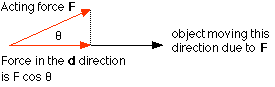
At θ = 0, cos θ = 1, and Fd cos θ is just F · d, as we might expect.
Net work is the result of the sum of the forces F acting on the object moving through displacement d. It does not track the individual component forces or the work associated with each of them; we need to know each force and its displacement in order to do that analysis.
Work by a changing force
Notice that F was not changing: we are considering only a constant force here. If we look at the more complex situation where either the acceleration or the mass or both are changing, we need to use calculus. We can plot the component of force in the d direction, F cos θ against the distance moved. Then work is the area (height * width) = F cos θ · &Delta d:
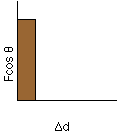
If we plot F out over d, we get a curve of force vs. displacement.
If the force is not constant, we can approximate the total work by breaking the force into incremental rectangular pieces and adding them up:
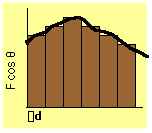
As we decrease the width of the incremental d (width), our approximation approaches the actual area under the curve. This area under the curve is work, and we can use integral calculus to determine its value for most continuous functions. So the general definition of work in all cases is:
For another presentation of these ideas, check out the Spark Notes for the SAT Physics Exam Review of the concept of work and energy.
Rocket Science
Consider the situation where a 1500kg space vehicle falls vertically from a height of 3000km above the earth's surface to the surface. We want to determine the work done by gravity.
In this case, the displacement d is 3000km, and the angle between F and d is zero, so cos Φ = 1. The earth's radius is 6380 000m , so the rocket falls from 9380000 to 6380000m. The force due to gravity is changing, however, as r changes between the center of the earth and the rocket:
Pulling out the constants:
The integral of 1/r2 is -1/r. We can see the plot of y = 1/x (think x = r). The integral of this is represented by the area under the curve.
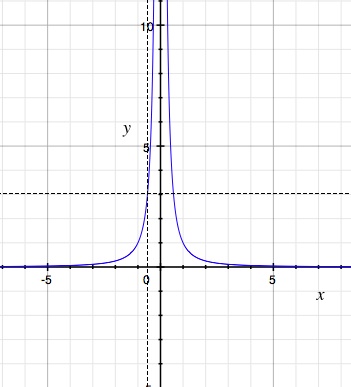
Curve y = 1/x2 |
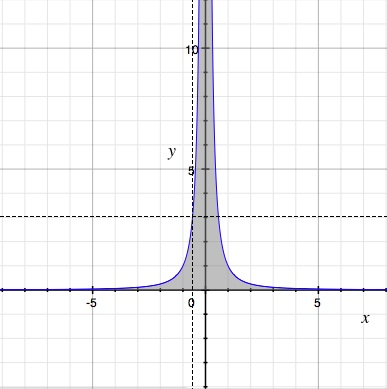
Integral of y = 1/x2= 1/x |
When we evaluate our expression for the falling rocket at the limits, the integral expression becomes
Substituting in the value 6380000 for r, and rearranging the factors we have
Substituting in values for G, Me, and msat as well, we wind up with the expression
This is the work done by gravity in moving the vehicle to the ground. It is exactly the same amount as the work done on the vehicle by the rocket fuel gasses when they put the craft at that distance above the surface.
Kinetic Energy
We started out with work as an attempt to understand energy, so now we consider energy of motion. We already realize that where there is displacement, there is motion, and we have been converting F = ma into different forms, depending on how we express a in terms of v and d.
So we can derive a relationship for work in terms of velocity: W = F · d = ma · d. If we consider the relationship
which we used in chapter 2, we see that we can substitue
into the work equation for a, and the work done becomes
Now we have these quantities which we have never seen before: mv2/2. But form the way we evaluated the situation, this is a change in energy due to something moving, so we all this kinetic energy, and work becomes the change in kinetic energy.
One of the consequences of this is that if v1 > v2, the work is negative and the kinetic energy decreases. When one one object does work on another, there is usually an exchange of energy, and the kinetic energy of one increases at the expense of the other's energy in some form. For example, when a hammer hits a nail, the velocity of the hammer decreases to zero, while the nail's velocity increases (if only briefly).
Work and energy have the same units. W = f· d = Newtons · meters = (kg · m/sec2)· m = kg · (m/s)2 (which is m· v2). This quantity is called a joule and is the universal unit for any form of energy. Heat energy, electrical energy in current flow, even chemical energy from exothermic reactions--all of these are expressed in joules. In the cgs system, the basic energy unit is an erg: 1 g · (cm/sec)2.
Potential energy
Potential energy is energy stored in the position of an object. This position can be in a field like gravity or electrical potential, or it can be in a chemical bond. To change the position of the object require a change (positive or negative) in its energy state. For example, the potential energy of a book above the ground is the work it took to lift the book to that height. Let go of the book, and the gravitational field takes over, converting the potential energy to kinetic energy of motion in the process. Potential energy is always a difference between two states of energy. If the potential energy increases, work was done on the object and energy was put into the system to create the increase in its energy state. If potential energy decreases, the object does work or converts its potential energy to some other form (usually but not always kinetic energy).
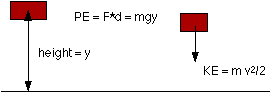
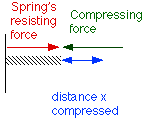
Springs are a good example of the way potential energy can be stored and released. Robert Hooke, a contemporary of Newton's, discovered a relationship governing the distention of a spring (that is, the compression or extension from its state of rest). The force with which the spring resists a change in its length is proporational to the change and to a constant such that
F/x = k, where F is the spring resistance, x is the distension, and k is the constant.
This accords with our experience that increasing the distension of a spring (depressing a scale further or pulling a screen door wider) requires the exertion of more force. The force that we exert is the equal and opposite force to the resistence the spring exerts.
Note that at each point on the compression of a spring, the spring resists with a force F = -kx (the force is exerted in the direction opposite to the compression). This force is changing constantly with x. It is zero when the spring is relaxed. So the force to push a spring to position x is an average of the distenson between 0 distension and x distension, or ½(0 + x) = ½x.
Now we can write the work done to compress the spring a distance x as
W = F · x = -k (½x)x = - ½(kx2).
Practice with the Concepts
Discussion Points
- Can centripetal force ever do work on an object?
- Can a normal force ever do work on an object?
© 2005 - 2026 This course is offered through Scholars Online, a non-profit organization supporting classical Christian education through online courses. Permission to copy course content (lessons and labs) for personal study is granted to students currently or formerly enrolled in the course through Scholars Online. Reproduction for any other purpose, without the express written consent of the author, is prohibited.