Physics
Chapter 5: Sections 8-10

Web Lecture
Newton, Kepler, and the Motion of the Planets
Introduction
By what reasons are you led to make the sun the moving cause or the source of movement for the planets?
Because it is apparent that in so far as any planet is more distant from the sun than the rest, it moves the more slowly—so that the ratio of the periodic times is the ratio of the 3/2 powers of the distances from the sun. Therefore we reason from this that the sun is the source of movement.
Johannes Kepler, The Epitome Of Copernican Astronomy
Outline
Newton and Kepler
Using Gravitational Force in circular motion of satellites
Assume, for a moment, that the moon orbits the earth in a perfect circle with a fixed velocity, which would be linear if it were not for the force of gravitational attraction. Its acceleration from the observered velocity and radius is a = v2/r. But this acceleration is due to gravitational force, or g = GM/r2. We can set the two equal to each other:
and use this relationship, along with 2*π*r/T = v, to determine acceleration and velocity of orbiting objects from their observed radius and period.
Newton and Kepler
Perhaps the most stunning achievement of Newton's was his ability to provide a causal explanation for the results of Kepler's painstaking analysis of the motions of Mars. Kepler had been an assistant of Tycho Brahe, a Danish astronomer who had his own observatory and created more accurate instruments than any available in Europe before his time. Tycho recorded the positions of Mars over many years. After his death, Kepler spent nine years trying to understand Mars' motion in terms of the new Copernican theory. He eventually published three empirical *"laws" which appeared to govern all planetary motion.
- Planets move in ellipses.
- A line from the sun to the planet sweeps out equal areas in equal times (or in more practical terms, a planet moves more quickly on its orbit when it is close to the sun than when it is far from the sun).
- The square of the period of a planet is proportional to the cube of its distance from the sun.
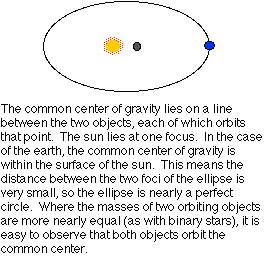
This short interactive "movie" will walk you through the derivation of Kepler's Laws. So that you can go out your own pace, the movie is set to advance when you click on it. Keep clicking: some slides have multiple actions before they can advance. The first and second laws are the direct result of Newton's discovery of the mutual attraction of the masses: not only does the sun attract the planet, but the planet also attracts the sun. When that is taken into consideration, the elliptical nature of the planetary orbits has a basis in the physical forces of the masses involved:
If this still doesn't make sense, review the Kepler tutorial at The Physics Classroom. The Animation button will show you how Kepler's second law (equal areas in equal times) works.
Empirical laws
An empirical law is a relationship based on patterns which have been observed, but for which no causal explanation (in terms of natural forces) has been found. A good example of a currently unexplained empirical relationship is Bode's law, which relates his observed distances of the planets from the sun to a mathematical relationship. In the table below, and AU is an astronomical unit, the distance between the earth and the sun.
| Planet | Distance from sun (in A.U) | Titius-Bode Relationship | Predicted distance |
| Mercury | .39 | .4 | |
| Venus | .72 | .4 + .1 * 3 | .7 |
| Earth | 1.0 | .4 + 2 *.3 | 1.0 |
| Mars | 1.52 | .4 + 4 * .3 | 1.6 |
| .4 + 8 * .3 | 2.8 | ||
| Jupiter | 5.2 | .4 + 16 * .3 | 5.2 |
| Saturn | 9.5 | .4 + 32 * .3 | 10.0 |
| Uranus | 19.2 | .4 + 64 * .3 | 19.6 |
| Neptune | 30.0 | ||
| Pluto | 39.4 | .4 + 128 * .3 | 38.8 |
Bode was convinced that some physical requirement lay behind this relationship, but no one has been able to define that relationship. We have, however, discovered the asteroids between Mars and Jupiter stradling an orbit 2.8 AU; and Pluto's elliptical orbit crosses Neptune's for about 10 years each revolution, making possible a near-collision which may have sent Neptune closer to the sun.
A similar relationship also works for the orbits of Uranus' moons!
Practice with the Concepts
© 2005 - 2026 This course is offered through Scholars Online, a non-profit organization supporting classical Christian education through online courses. Permission to copy course content (lessons and labs) for personal study is granted to students currently or formerly enrolled in the course through Scholars Online. Reproduction for any other purpose, without the express written consent of the author, is prohibited.