Physics
Chapter 5: Sections 4-7

Web Lecture
Universal Gravitation
Introduction
The Rules of Reasoning in Philosophy
Rule III
The qualities of bodies, which admit neither intension nor remission of degrees, and which are found to belong to all bodies within reach of our experiments, are to be esteemed the universal qualities of all bodies whatsoever.
For since the qualities of bodies are only known to us by experiments, we are to hold for universal, all such as universally agree with experiments; and such as are not liable to diminution, can never be quite taken away. We are certainly not to relinquish the evidence of experiments for the sake of dreams and vain fictions of our own devising; nor are we to recede from the analogy of Nature, which is wont to be simple, and always consonant to itself. We no other way know the extension of bodies, than by our senses, nor do these reach it in all bodies; but because we perceive extension in all that are sensible, therefore we ascribe it universally to all others, also. That abundance of bodies are hard we learn by experience. And because the hardness of the whole arises from the hardness of the parts, we therefore justly infer the hardness of the undivided particles not only of the bodies we feel but of all others. That all bodies are impenetrable we gather not from reason, but from sensation. The bodies which we handle we find impenetrables and thence conclude impenetrability to be a universal property of all bodies whatsoever. That all bodies are moveable, and endowed with certain powers (which we call the forces of inertia) or persevering in their motion or in their rest, we only infer from the like properties observed in the bodies which we have seen. The extension, hardness, impenetrability, mobility, and force of inertia of the whole result from the extension, hardness, impenetrability, mobility, and forces of inertia of the parts: and thence we conclude that the least particles of all bodies to be also all extended, and hard, and impenetrable, and moveable, and endowed with their proper forces of inertia. And this is the foundation of all philosophy. Moreover, that the divided but contiguous particles of bodies may be separated from one another, is a matter of observation; and, in the particles that remain undivided, our minds are able to distinguish yet lesser parts, as is mathematically demonstrated. But whether the parts so distinguished, and not yet divided, may, by the powers of nature, be actually divided and separated from one another, we cannot certainly determine. Yet had we the proof of but one experiment, that any undivided particle, in breaking a hard and solid body, suffered a division, we might by virtue of this rule, conclude, that the undivided as well as the divided particles, may be divided and actually separated into infinity.
Lastly, if it universally appears, by experiments and astronomical observations, that all bodies about the earth, gravitate toward the earth; and that in proportion to the quantity of matter which they severally contain; that the moon likewise, according to the quantity of its matter, gravitates toward the earth; that on the other hand our sea gravitates toward the moon; and all the planets mutually one toward another; and the comets in like manner towards the sun; we must, in consequence of this rule, universally allow, that all bodies whatsoever are endowed with a principle of mutual gravitation. For the argument from the appearances concludes with more force for the universal gravitation of all bodies, than for their impenetrability, of which among those in the celestial regions, we have no experiments, nor any manner of observation. Not that I affirm gravity to be essential to all bodies. By their inherent force I mean nothing but their force of` inertia. This is immutable. Their gravity is diminished as they recede from the earth.
— Isaac Newton, The Mathematical Principles of Natural Philosophy
Outline
Universal Gravitation
One of the great abstractions of human history occured when Isaac Newton postulated that each mass in the universe attracts every other mass in the universe with a force proportional to the masses of the two objects and inversely proportional to the distance between the two, or
The Law of Universal Gravitation:
His reasoning for the relationship to distance between the two objects was based on an analysis of the motions of the moon--and an error in the calculated distance of the moon kept his results from publication for over ten years.
While Newton was able to describe the relationship between distance and masses, and realized that a specific proportional constant was required, he did not determine the value of that constant accurately. This was done by Henry Cavendish (1731-1810), one of the great scientists of the eighteenth century, who also discovered hydrogen and argon, and measured capacitance a century before Maxwell.
In order to measure the gravitational constant, Cavendish set up a torsion balance. This uses a fine fiber that resists twisting to support a bar with equal masses hung from each end. Cavendish used small lead balls for the balance masses, then placed much larger lead balls near them.
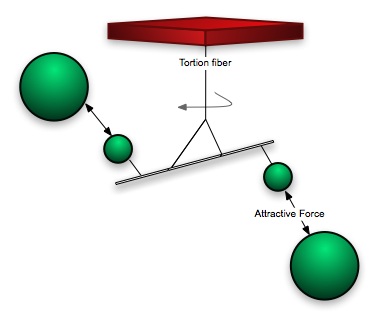
After setting up his experiment to eliminate air currents, possible electrical charges, Cavendish was able to determine the value of G. There is a detailed picture of how it worked in the COMSOL Blog entry celebrating Cavendish's birthday in 2020.
Much of Cavendish's work was ignored or unpublished for over a century.
The factor G is called the universal gravitational constant. It is the number (in units appropriate to those used for mass and distance in a given case) that gives the observed force of attraction between two masses (and note, we mean any two masses, not just the earth and some other mass). While this may seem a little like fudging the data, it really is not. G is a constant of proportionality, just like the value π is the constant of proportionality between the diameter of a circle and its circumference. We have to use G in every instance of gravitational force calculations. It is, so far as we can tell, a constant everywhere and at all time throughout the universe, and so ranks as a fundamental constant. Its value is an artifact of our units of measurement, but its existence and presence in the equation is not. If we use different units, we will need a G which will work for those units.
The realization that such a simple relationship governs the motion of all the stars and planets and every tidbit of matter on earth was not easily accepted by many people, and matters were made worse by the fact that Newton did not explain how gravity worked. Nor has anyone since been able to provide a mechanical explanation for gravity. We simply know from observation that every mass we encounter attracts every other mass in this way, regardless of the composition of the mass, or the amount of matter (or lack of it) between them. In other words, gravity does not require a medium through which it must exert its force.
There are other fundamental constants. One shows up in the force resulting from electrical charge, another is Plank's constant in the relationship between photon energy and wavelength, and still another is the speed of light, c, which relates energy and matter.
The weight of an object near the earth's surface can be expressed in terms of Newton's force of gravity formula:
where M is the mass of the earth and m is the mass of the object. We can solve this for g by eliminating m from both sides of the equation:
which makes sense. The gravitational acceleration experienced by an object near the surface of any planet is a function of the mass of the planet and its size, but not of the mass of the object. The force acting on the object is a function of the mass of the object, since it is still F = ma.
We can measure g, G, and r fairly accurately near the surface of the earth using satellites. If we plug in the values for the three, we can solve for the mass of the earth.
Practice with the Concepts
Example
The key to solving circular motion problems is realizing that the net acceleration on the object must be the source of the circular motion. This force could be tension in a string, or gravity, or electrical attraction.
A child on a merry go round moves at 1.35 m/s when 1.20 m from the center of the merry-go-round.
We know:
- mass: 25 kg
- tangential speed v : 1.35 m/sec
- radial distance r: 1.20 m
We need to determine: Centripetal force Fc = mv2/r .
We know all the variables, so we can just plug and calculate:
- Fc = (25 kg) (1.35 m/sec)2 / (1.20m) = 25 kg * 1.52 m/sec2 = 38.0 Newtons
Discussion Points
- Does an apple on a tree exert a gravitational force on the Earth? Does a falling apple exert a gravitational force on the Earth?
- Will an object weigh more at the poles or the equator? What forces are at work in each location? How do they differ?
© 2005 - 2026 This course is offered through Scholars Online, a non-profit organization supporting classical Christian education through online courses. Permission to copy course content (lessons and labs) for personal study is granted to students currently or formerly enrolled in the course through Scholars Online. Reproduction for any other purpose, without the express written consent of the author, is prohibited.