
Physics
Chapter 4: 8 Newton's Third law

Web Lecture
Force, Motion, and Weight Applications
Introduction
Friction is divided into three parts: these are simple, compound, and irregular.
Simple friction is that made by the thing moved on the place where it is dragged.
Compound friction is that which the thing moved makes between two immovable things.
Irregular friction is that made by the wedge of different sides.
— Leonardo da Vinci, Notebooks
Now we look at more realistic situations: those involving friction as well as gravity. The study of interacting surfaces or friction is called tribology, from the Greek τριβω or "rub". While Leonardo da Vinci's notebooks contain not only studies on friction but also diagrams of devices to reduce friction with bearings, his work lay unread for nearly three centuries. The rules explaining friction were rediscovered and credited to Guillaume Amontons in the seventeenth century, with adjustments made by Charles August Coulomb (whom we will meet again when we study electricity):
- The amount of friction between two surfaces is proportional to the the force pressing one surface into the other (normal force).
- The amount of friction is independent of the size of the contact area.
Outline
Applications of Newton's Third Law
Friction on an flat surface
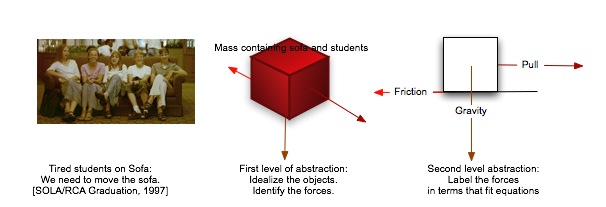
One of the things that we need to do is learn to think like a physicist, which basically means looking at a real situation and then making an abstraction of the physical entities that interest us. This is particularly true when we have to identify all the forces acting in a given situation. In the diagram above, we start with a "real" situation: a number of tired students who have been talking all night, sitting on a sofa. We want to slide the sofa sideways.
The next step is to idealize the situation. First, we realize that from the physicist's point of view, we are interested in the total mass of the students and the sofa, and we can lump this all together as a single mass, roughly equivalent in shape to a cube. The earth exerts a pull down on this mass; we want to exert a pull forward, and the rug will resist this pull, so we have three forces to worry about. We already know something about gravitational force. The amount of friction force resisting the motion of a body over a surface depends on the characteristics of the object and the surface.
Finally we are in a position to analyze the situation. We can name the forces and give them each measured or calculated values. We may need to break down one or more forces into components in order to sum them up and determine the net force acting on the sofa. We need to feel comfortable doing this in both simple sitautions like the one above, and in more complex situations like the ones described below and in your text.
Friction on an Incline
Our analysis of the situation with Athos falling down the well ignored the friction on the rope at the point where it was sliding over the bar. Physicists often will ignore small contributory factors to get an estimate of a situation, just to simplify the math and analysis. Once they understand the big contributing factors, they turn their attention back to any factors they previously ignored.
So let's look at a more realistic situation. We will analyze forces uses diagrams called free-body or force diagrams. We have to identify each force and show the direction it operates. In a detailed force diagram, the length of the vector would reflect its magnitude, but we can always just stick in the numbers for magnitude once we know which direction the vectors point.
Friction is the resistance to movement caused by roughness in the contact surfaces between two bodies. Later we will talk about how this resistance causes loss of energy in systems, but for now, we just want to look at how frictional forces contribute to the motion of bodies on surfaces. Friction is always a function of the forces on that surface, that is, the forces perpendicular to the surface. We call these forces normal forces.
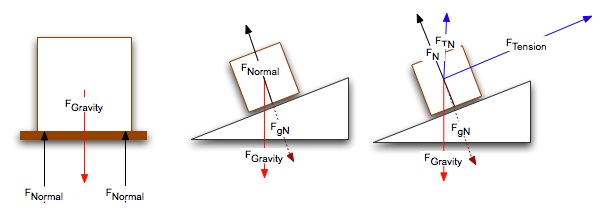
If we are looking at a box resting on a horizontal surface, the normal force is equal to the gravitational pull on the box (first example below). If the box is on a ramp, then we have to consider the component of the gravitational pull normal (or perpendicular) to the surface between the box and the ramp. If the box is actually sliding upward (so that the gravitational pull is cancelled out by the tension on the rope), then we have to look at the normal force due to the upward component of the tension as well as the gravitational normal force component due to the downward gravitational force.
Notice that in this last case, the normal force arrow is up rather than down: we are concerned with the force of the ramp on the box as it affects the motion of the box. The frictional force between the two has the same magnitude. We choose direction based on the format of the question.
Friction depends on many factors, only one of which is the normal force. We write the relationship between friction force, the normal force, and these factors as Ffr = µFN. The little µ takes into account surface roughness, surface area, and anything else particular to the contact surfaces themselves. It also takes into account differences between sliding friction (resistance to motion of a moving body due to the contact surfaces) and static friction (resistance to motion of a motionless body due to the contact surfaces). Sliding or kinetic friction is always less than static friction, so Fµk <= Fµs.
Let's assume that the angle between the force of gravity and the normal force is θ. For the three situations above, we have the following calculations:
- Stationary box on a flat surface. The normal force is equal and opposite to the gravitational force, and the frictional force is equal to the normal force times the coefficient of static friction: Ffr = µsFN = µs[-FG]
- Stationary box on a slanted surface. The normal force is equal and opposite to the component of the gravitational force normal to the surface, and the frictional force is the coefficient of static friction times this normal force: Ffr = µsFN =µs[-FG * cos θ]
- Moving box on a slanted surface. The normal force is equal and opposite to the component of the gravitational force normal to the surface, and the frictional force is the coefficient of kinetic friction times this normal force: Ffr = µkFN = µk[-FG * cos θ]
Friction problems may seem more complicated, but in concept they are simply an extension of Newton's realization that we have to sum all the forces acting on a body. In application, we are back to the crucial step, which is identifying those forces and representing them appropriately. The best tool for doing this is the force vector diagrams which we have been using above, and which are used throughout your book. The most basic rule of dynamics applications is diagram all the forces. Then the math is easy.
Practice with the Concepts
Discussion Points
- Show that the minimum stopping distance for an automobile traveling on a level road at speed v is equal to where ms is the coefficient of static friction between the tires and the road, and g is the acceleration of gravity.
© 2005 - 2026 This course is offered through Scholars Online, a non-profit organization supporting classical Christian education through online courses. Permission to copy course content (lessons and labs) for personal study is granted to students currently or formerly enrolled in the course through Scholars Online. Reproduction for any other purpose, without the express written consent of the author, is prohibited.