
Physics
Chapter 4: 5-7 Newton's Third law

Web Lecture
Force, Motion, and Weight
Introduction
AXIOMATA, SIVE LEGES MOTUS
[Leges solæ descripta sunt, commentariis prætermissis.]
- Lex III
Actioni contrariam semper & æqualem esse reactionem: sive corporum duorum actiones in se mutuo semper esse æquales & in partes contrarias dirigi.To every action there is always oposed an equal reaction: or, the mutual actions of two bodies upon each other are always equal and directed to contrary parts.
— Isaac Newton, Principia Mathematica Definitions
Outline
Vectors and Newton's Laws
A body changes its state of motion only as a result of the net forces acting on it. This is the law of inertia. If we know a force is acting on a motionless body, or we see a body change direction, speed up, or slow dow, we have a net force acting.
We need to develop ways to analyze all the forces that could cause a body to move. At the moment, we are concerned only with force sthat cause a body to move with translational motion, that is, to translate or change its position, so we consider only those motions where objects move through space as though forces acted on their centers of mass. Later we will consider objects which rotate as a result of "off-center" forces.
Mass and weight
First, we need to define mass as the quantity of matter in an object. In standard internation units, that is, for all scientific purposes these days, mass is measured in kilograms. If you are used to thinking of mass and weight as the same thing, you now need to make a distinction between the two. Weight is a measure of the pull of the earth's gravitational field on a given mass. Weight is a force; mass is property of matter and not a force.
The force unit a combination of mass units and acceleration units, since F = ma. It is (not surprisingly) named after Sir Isaac: 1 newton of force is necessary to increase the velocity of one kilogram of matter by 1 meter per sec each second, or
1 N = 1 kg * 1 m/sec2
In almost all work in this class, we'll stick to internation units. If we need something smaller than newtons, we will use dynes, where 1 dyne = 1 gram * 1 cm/sec2.
We can use the equivalence of 1 kg = 2.2lbs, where we mean a one-kg mass will exert a 2.2 lb. force at the earth's surface near sea level (with acceleration = 9.81 m/sec2). To represent our British pound of force similarly, we need a unit of mass, which has been named the slug:
1 pound = 1 slug * 1 foot/sec2
We can also determine the conversion factor for pounds to Newtons.
1 kg = 2.2 lbs, so 1 lb = .454 kg
1 lb = .454 kg * 9.8m/sec2 = 4.45 N
The average adult at 150 pounds exerts a force of 667.5 N on the ground, and the ground (according to Newton's third law) returns the force, thus keeping our adult standing still.
So to get a rough estimate one measure in terms of the other unit system:
- given pounds, divide in half to estimate the number of kilograms
- given pounds, multiply by 4.5 to get Newtons
- given kilograms, double to get pounds
- given Newtons, divide by 4 to get pounds
Newton's laws (modern formulation)
| First Law | A body retains its constant velocity unless acted on by an outside force. | Inertia |
| Second Law | The change of motion is proportional to the motion force impressed; and is made in the direction of the right line in which that force is impressed. | F= ma |
| Third Law | To every action there is always opposed an equal reaction: or, the mutual actions of two bodies upon each other are alwys equal, and directed to contrary parts. | F 1= - F2 |
Look, for a moment, at the implications of Newton's laws. According to the first law, no change of motion can take place unless a force is involved. So any time we observe acceleration -- which, you recall, can be either a change in a body's speed (velocity's magnitude) or a change in its direction, or both -- we can calculate the equivalent force involved. If we are in an inertial frame of reference--that is, we are not ourselves accelerating, then the force we perceive is real. If we are accelerating, the acceleration we perceive in other objects will have at least some non-real force component.
The second law tells us that that the force acting on a body is directly proportional to the mass of the object whose velocity is changing, and to the rate of that change, that is, to the acceleration: F = ma. We can determine the force by looking at the acceleration.
The third law is a bit less intuitive, but can be deduced thus: if we know that one body (such as a horse) is exerting a force on another body (such as a cart stuck in the mud) , and neither body is moving (so a = 0), then there must be another force operating on the first body (the horse) in an equal and opposite direction to keep that body from moving. Or, to put it more simply, the cart is pulling the horse as much as the horse is pulling the cart.
This leads us to the application of all these principles: Σ F = ma. The sum of all the forces on a given body produce the acceleration experienced by the body. Think of a tug-of-war, with two teams on each end of a rope. The winning team manages to exert a greater force than the losing team: the sum of the forces is in the direction of the winning team's force.
Note that we are multiplying the acceleration vector by the scalar magnitude mass. All vectors can be multiplied by a scalar; the only thing that changes is the magnitude of the vector. So the direction of the resulting force is in the direction of the overall acceleration. Later we will talk about multiplying vectors together.
Ideally, we look only at the body in which we are interested, without reference to any other bodies--so this is a free body (free of any other influences than the forces we have identified).
It is really that simple in principle. Now let's look at a couple of applications.
Applications
- Richard P. Feynman
The point at which we usually become confused in applying Newton's laws to a situation is in identifying all the force vectors against some coordinate system. After we have done that correctly, most of the rest of any problem resolves itself to mere calculation.
In the 1977 movie The Three Muskateers, Athos (played by Oliver Reed) falls down a well. He grabs onto the bucket, which is attached to a rope slung over the freely rotating rod attached to the well-house, and hollers for help. When Aramis (Richard Chamberlain) and Porthos (Frank Findlay) arrive, they grab the tail end of the rope and start pulling Athos up. Assumsing that Athos is a good 15 stone or so (British for 14 pounds), he tips the scales at 210 pounds, which at 1kg/2.2 pound is about 95 kg. Let's assume he falls for 15 seconds before Aramis and Porthos grab the rope and begin pulling him out, and that, because of their weakened condition (from fighting off Cardinal Richelieu's spies), they can exert only 500N each. The rope slides smoothly across the rod (no friction). How long does it take them to get Athos out of the well?
| Plan | What we know | Formula | Result |
|---|---|---|---|
| Figure out how fast Athos is going when Porthos and Aramis grab the rope. | Only downward motion is involved in this step. The inital velocity = 0, the time falling= 15 seconds, and the acceleration due to gravity = 9.8 m/sec2 | v = v 0 + at | v = 0 + 9.8m/sec2 * 15 sec = 147 m/sec. |
| Figure out how far down Athos fell. | The initial distance is 0, initial velocity = 0, the time falling= 15 seconds, and the acceleration due to gravity = 9.8 m/sec2 | x = x0 +v0t + ½at2 | x = 0 + 0 + ½(9.8m/sec2) * (15 sec)2 = 1102 meters....almost 3000 feet! Better be a realllllly long rope. |
| Identify all the forces acting on Athos at the instant Porthos and Aramis come to the rescue and assume the forces don't change during the course of the rescue. | 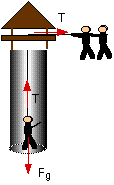 |
Fg = mg
T = 2 * 500N = 1000 N; this is T in both places, because the rope isn't stretching. |
The gravitational force on Athos is 95 kg * 9.8 m/2 = 931 N.
The total force exerted by our heroes is 1000 N. The net force on Athos (before friction) is 1000N - 931N = 69N upward. |
| Determine the upward acceleration on Athos. | The force on Athos | F = ma | 69N/95kg = .72m/sec2 |
| Determine the length of time it takes to pull Athos out. | Athos' starting velocity is zero, he has fallen 147 m, and he is undergoing an acceleration of .72m/sec2. Assume that his original displacement is zero (we are only concerned with getting him out of the well). | x = x 0 + v0t + 1/2 * at2 | 1102 = 0 + 0 + ½(.72)t2, so
t = sqrt(2 * 1102/.72) = 55.33 seconds. |
Notice that all the units cancel so that we wind up with time units. When you work problems, set up the units as well as the numbers. You can only add or subtract factors with the same kind of uits. You can multiple and divide units to create new unit entities. If the result you calcalate doesn't have the right units, something is wrong with your calculation.
Practice with the Concepts
Discussion Points
- When an object falls freely under the influence of gravity there is a net force mg exerted on it by the Earth. Yet by Newton's third law, the object exerts an equal and opposite force on the Earth. Why doesn't the Earth move?
© 2005 - 2026 This course is offered through Scholars Online, a non-profit organization supporting classical Christian education through online courses. Permission to copy course content (lessons and labs) for personal study is granted to students currently or formerly enrolled in the course through Scholars Online. Reproduction for any other purpose, without the express written consent of the author, is prohibited.