Physics
Chapter 3: 1-4

Web Lecture
The Mathematics of Kinematics
Vectors
Introduction
On October 16, 1843, which happened to be a Monday, and a Council day of the Royal Irish Academy—I was walking in to attend and preside, along the Royal Canal, and under-current of thought was going on in my mind, which at last gave a result, whereof it is not too much to say that I felt at once the importance. An electric current seemed to be close, and a spark flashed forth,...I could not resist the impulse ... to cut with a a knife on the stone of Brougham Bridge, as we passed it, the fundamental formulae...
— William Rowan Hamilton
Hamilton's formula, q = w + ix + jy + kz, is no longer on the bridge, but a plaque marks the spot. For more on the history of vectors, check out the Vectors article at McGill's math department.
Outline
We've already seen that a vector is a very useful concept when we need to determine numerical data for a direction-specific phenomenon like motion. We rely on vectors not only in kinematics (motion) and dynamics (force) studies, but throughout physics, in electricity, magnetism, and thermodynamics--in fact, wherever we need to show magnitude and direction of a changing quantity as a single entity. So far we've only looked at "one-dimension" vectors, that is, vectors that lie on the same line, but possibly point in opposite directions. Now we are going to look at what happens when related vectors like velocity and acceleration don't lie on the same line. Note to the wise: Invest the time now to become very familiar and comfortable with vector manipulation; you are going to spend a lot of time in this class doing it.
Problems Tracking Distance and Time
Let's revisit the concept of vectors, but this time, consider the implications for combining vectors that do not lie on the same line. Vectors always have two parts: a scalar magnitude V, which shows how big the vector is, and a direction →, which shows the change in position with respect to some coordinate system or origin, of the vector quantity V. In the previous chapter, we discussed vectors whose direction was either positive or negative in a single dimension (right-left, up-down). Now consider the general case. Motion could be a direction in physical 3D space, and we could map it in one plane (north by northwest) as well as up or down. Or even more generally, our vector coud represent any directional change, like charge density in an electrical field originating from an ion, or the temperature gradient across a weather front.
Right now, though, we'll stick to kinematics and dynamics, and use vectors primarily to represent velocity, acceleration, and force.
Kinematics in Two and Three Dimensions
Vectors in physics are always abstractions of some particular physical situation, so we need to not only understand how to manipulate the vectors, but what they tell us about the physical quantities they represent. The scalar magnitude for velocity indicates how fast the object is moving; the direction shows what direction the object is moving with respect to some origin and set of axes. The scalar magnitude for acceleration shows the rate at which velocity is changing, and the direction compared to the direction of the velocity vector will show whether the velocity magnitude is changing, or its direction, or both.
Graphical approach to assessing vectors
One way to evaluate vectors is to draw them with respect to some convenient frame of reference or coordinate axes, and to make their lengths proportional to their scalar magnitude.
Consider the case of John, who goes for a walk one day. He starts off briskly, walking at 4 mph, due east, for 10 minutes, so he goes [using dimensional analysis of the units to make sure we set the problem up correctly]:
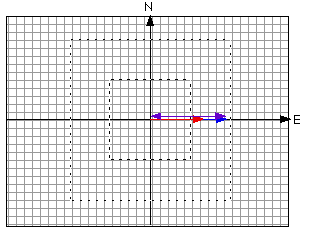
His displacement vector (D1 red arrow, below) at the end of leg 1 of his walk shows him 2/3m due east of his point of origin.
Then he comes to a stoplight, and when he crosses the street, his pace slows because he is passing the windows of some interesting shops. Now he is traveling at 2 mph, but still due east, for 15 minutes (= 1/4 hour): 2mph * h/4 = 1/2 m.
For the second leg, we have a 1/2m displacement due east of the stoplight (D2 blue arrow--notice different start for the displacement). We can figure his total displacement by "adding" the vectors, placing them in sequence head to toe (purple arrow)
Now consider what happens when John suddenly remembers an important date at the library. He turns north and runs for it, covering the mile to the library in 6 minutes (did we mention John is on the track team)? The new vector for displacement from Main Street must be drawn in the north direction, with a magnitude of 1 mile (D3 green arrow).
We can draw the overall displacement D from home (black vector).
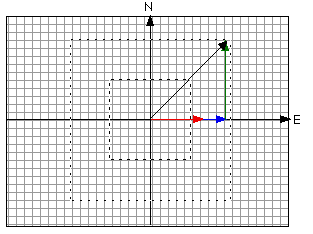
Vector signs (graphically represented as arrowheads) indicate direction, not magnitude. So if John now runs back to Main Street with its shops, the vector points south or negative to our positive north coordinate system, and his displacement Main Street to Library to Main Street is zero (although he still isn't back home yet). Note that we are still using a head-to-toe or "tail-to-tip" method of placing the vectors for addition.
Since the length of the vector indicates its magnitude, if John runs twice as far from the library as he ran to the library, we can indicate that by doubling the return vector, putting John south of Main Street one mile (2D4). Now we can determine the total displacement from home by adding all the vectors and creating a summation vector, which has its origin at John's starting point and its arrow at his final location (black arrow). Although John has covered more than three miles, he's still just over a mile from home.
The (ahem) analytical approach
Another way to approach the problem (and one which is actually easier in many cases, and certainly more precise, than using the graphical method) requires a little trigonometry [if you need trig review, check out the trig tutors and texts listed on the web sites below]. We can break down our vectors into x and y components based on a convenient set of axes (we'll use y positive in the north direction and x positive in the east direction for John's walk).
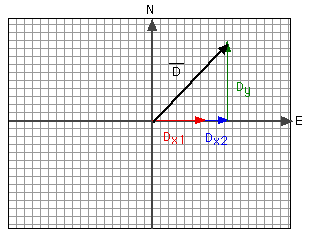
We represent the first two legs of John's journey with just Dxn vectors, since he didn't go north or south, and the third leg with just a Dy vector. Now we can add the three displacement vectors, taking direction into account, by looking at the resulting triangle. The magnitude of the overall displacement is the hypoteneuse of the triangle. This, from Pythagoras' theorem, is:
which reduces numerically to ( (.66 + .25)**2 + (1.0 )**2) = 1.36 miles.
Note that the order in which we add the vectors doesn't matter (commutative law) nor does it matter if we group some together before adding the others (associative law), just like addition with regular integers.
So we have length D. Now how do we represent direction with our analytic method? We use trigonometry and angles based on our coordinate system.
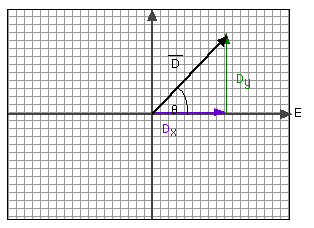
Consider the walk from from John's point of origin to the library where he is at the end of leg three (green).
We could use any one of several trig functions, but the easiest is probably to determine θ based on the relationship
tan θ = Dy /Dx = 1/.91 = 1.0989 ~ 1.1.
Using the reverse function on the calculator tan-1 to get the angle for which the tangent is 1.1 gives us θ = 47.7°.
Notice that in this case, both x and y are positive. The sign of the component tells us something about the direction. By convention, we can label the quadrants around an x-y axes system as I, II, III, IV thus:
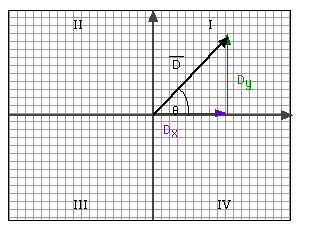
If x is positive, the end point of the displacement vector lies in quadrants I or IV; if y is positive, it lies in I or II. So if both are postive, it must lie in I; if both are negative, it will lie in III.
We can also break down a vector into its x and y components. Consider at John's displacement at the library, viewed from home as the point of origin. It has a Dx and Dy component, based on the trigonometric relationships between D and θ:
Dx = D cos θ
Dy = D sin θ
Knowing Dx and Dy is equivalent to knowing D (the magnitude of D) and θ-- either way, you can determine John's position.
Putting it all together:
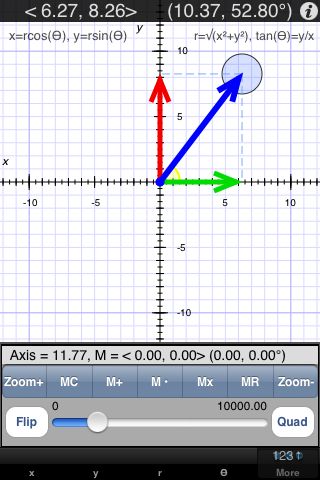 |
This diagram shows a "complete" analysis of a vector (blue) with its vertical (Dy, red) component and its horizontal (Dx green) component. The vector begins at the graph origin and ends at a point 6.27 units to the right (Dx) and 8.26 units above the horizontal axis (Dy). This gives it a length of 10.37 units at an angle 52.80° above the right axis, using the conventional method of counting angles from the right counterclockwise up. |
 |
This diagram shows the convention of a vector on a standard plot to the left: note that the Dx value of -7.80 is negative, and the angle is between 90° and 180° |
Practice with the Concepts
Work through the example below. Be sure that you understand when to use sin θ cos θ, and tan θ to determine the angle for the resultant vector.
Example:
What is the y component of a vector in the xy plane whoes magnitude is 88.5 and whose x component is 75.4? What is the direction of this vector (that is, what is the angle it makes with the x-axis?)
From basic trigonometry, we know that the Pythagorean theorem describes the relationship between two sides of a right triangle (the x and y sides) and the hypoteneus between them:
h2 = x2 + y2
In vector math using component x and y vectors, we know that the magnitude of the resulting vector r is just the pythagorean magnitude of its x and y components:
Vr2 = Vx2 + Vy2
In this problem, we are given the magnitude Vr = 88.5 and the x-component Vx = 75.4.
We can first solve our vector relationship for Vy:
Vy2 = Vr2 - Vx2
Vy = √ (Vr2 - Vx2)
Then we substute in our values:
Vy = √ ( ( 88.5 )2 - (75.4)2) = √ (7832.25 -5685.16) = √(2147.09) = 46.337
Since we have at most 1 significant decimal, this reduces to Vy = 46.3.
The angle is determined from the trigonometric relationship: cos α = Vx/V = 75.4/88.5 = 0.852.
The angle is thus cos -1 0.852 = α = 31.6 degrees.
Discussion Points
- Can the displacement vector for a particle moving in two dimensions be longer than the length of the path (distance) of the particle over the same time interval? Can it be less?
- Can two vectors of unequal magnitude add up to give a zero vector? Can three unequal vectors do so?
Helpful Trig Websites
© 2005 - 2026 This course is offered through Scholars Online, a non-profit organization supporting classical Christian education through online courses. Permission to copy course content (lessons and labs) for personal study is granted to students currently or formerly enrolled in the course through Scholars Online. Reproduction for any other purpose, without the express written consent of the author, is prohibited.