Natural Science - Year II
Unit 61: The discovery and exploration of the Planets

History Weblecture for Unit 61
| This Unit's | Homework Page | History Lecture | Science Lecture | Lab | Parents' Notes |
For 2026: Please note that units are considered "under revision" until two weeks before the class date, and page content, web assignments, and exercises may change before that deadline.
History Lecture for Unit 61: The Discovery of the Planets
For Class
- Period: 1750-2000 A.D.
For the interactive timelines, click on an image to bring it into focus and read notes.
Click on the icon to bring up the timeline in a separate browser window. You can then resize the window to make it easier to read the information.
Click here: Timeline PDF to bring up the timeline as a PDF document. You can then click on the individual events to see more information if you want. Exploring this version of the timeline is optional!
- Geographic Location: World
- People to know: William, Caroline, and John Herschel; Guiseppi Piazzi, John Challis and Johan Galle, Percival Lowell, Clyde Tombaugh.
- See science topics: Planetary Geology
Lecture:
The Planets
The planets Mercury, Venus, Mars, Jupiter, and Saturn are visible to the naked eye, and we really don't know when men first put names to them, or decided they were "wanderers" against the more permanent background stars. This Babylonian cuneiform tablet from the reign of Artexerxes (460 years before the birth of Jesus the Christ) describes Jupiter as stationary in Pisces.
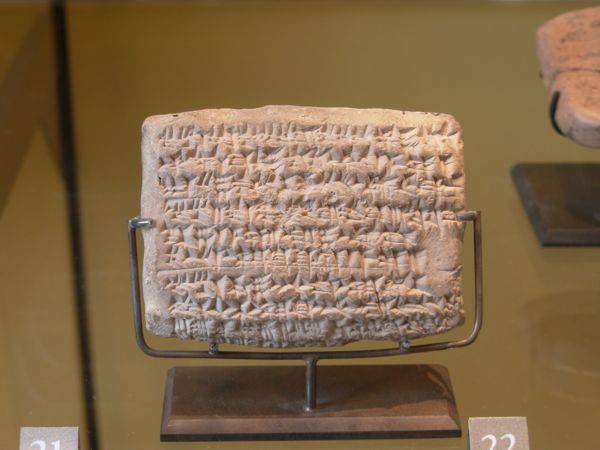
Christe Ann McMenomy 2007 Paris: the Louvre
Planetary Discoveries with the Telescope
The discovery of Uranus, Neptune, and Pluto depended on the use and improvement of telescopes. The first planet discovered with a telescope was Uranus. Its discover was born and named Friedrich Wilhelm Herschel in Hanover, Germany, but when he moved to England as a young adult, he changed his name to Frederick William Herschel and was widely known as William. He was primarily a musician, playing the violin, oboe and organ. He gave concerts as director of the orchestra in Bath, England, and his sister Caroline appeared as the soprano soloist.
When they were not making music for the amusement of others, William and his sister spent their time stargazing. William was so good at his observations (useful for calendar-making and navigation) that he became the King's Astronomer to George III.
William built telescope after telescope -- more than 400 all together, trying to improve his ability to resolve and magnify the objects he observed. Caroline made her own observations, but also helped William record his observations: new moons of Saturn (Enceladas and Mimas), new moons of Uranus (Titania and Oberon). He showed that the solar system as a whole was moving through space, and that the Milky Way had the shape of a disk.
Even after William's marriage, his sister Caroline continued to work as his assistant. She had her own telescopes and independently discovered comets, and M110, a companion to the Andromeda Galaxy. For her work she was given her own stipend from King George — unusual employment for a women in those days. She was the first woman presented with a Gold Medal from the Royal Society, which recognized her in 1828 for her astronomical work; the next woman so recognized was Vera Rubin (who did work on the rotation of galaxies) in 1996, almost 170 years later. She was even made an honorary member of the Society.
After his death, William's son John continued his astronomical work. If you don't like the Julien calendar, blame John: he was responsible for its use in astronomy. He named most of the moons of Saturn and Uranus after his father discovered them, and if that wasn't enough, he investigated the causes of color blindness. During his trip to South Africa, John observed Halley's comet and, as a recreational respite from the rigors of astronomy, with his wife Margaret he produced a catalog of South African flora. He was intrigued by the theories of Charles Lyell (whom you'd better remember from our discussions of geological theories) and agreed with a gradualist view, rather than a catastrophic one, of geological formations. His views influenced Charles Babbage in that mathematician's design of the first programmable computer. While he was in Africa, the HMS Beagle dropped anchor at Cape Town, and John Herschel met with Charles Darwin, who refers to John as "one of our greatest philosophers" in the introduction to The Origin of Species.
Read through the brief descriptions of the discovery of these planets: click on the Discovery section title, then read through the six sections on Ancient and Greek discoveries, the Renaissance, the age of the Telescope, Galileo, discovering new planets, and planetary satellites.
- Why was the discovery of Uranus "accidental"?
- Why was the discover of Neptune not "accidental"?
- Was Pluto's discovery accidental or not? What characterizes accidental discoveries in science?
Planetary Exploration with Spacecraft
Exploration of the planets (including Earth) from near space became possible with the launch of Sputnik 1 in 1957. This event also touched off the "space race". As with the efforts to discover new elements a century earlier, the United States and the Soviet Union attempted to gain prestige by being the first to achieve the goals of putting men in space, or sending craft to other planets.
Review the NASA Chronology of Lunar and Planetary Exploration, which lists every mission, successful or not, for any nation from Sputnik in 1957 through planned launches in 2022.
- Count the number of expeditions launched from the beginning of 1957 through the end of 1963. How many of these resulted in a successful launch? How man of these resulted in a successful mission (note that the word "attempted" in the description indicates that the spacecraft did not accomplish the stated goal)?
- What were the earliest missions to each of the planets, asteroids, moons (including Earth's Moon)?
- What were the earliest missions to comets?
- Most of the early missions through the mid-1980s were flown by either the USSR or the USA. Which nations launched missions of their own after this point? Which nation(s) participated in the Mars express mission (launched in 2003)?
- Read through the descriptions of the following key successful missions and note what discoveries or technical accomplishments they provided (dates given are launch dates).
- 1962 Mariner 2
- 1964 Mariner 4
- 1966 Luna 9
- 1969 Apollo 11
- 1970 Venera 7
- 1973 Skylab
- 1973 Mariner 10
- 1975 Viking 1 and 2
- 1977 Voyager 1 and 2
- 1985 Sakigake
- 1989 Magellan
- 1989 Galileo
- 1990 Ulysses
- 1996 Pathfinder
- 1997 Cassini
- 2004 Rosetta
- 2006 New Horizons
- 2007 Dawn
- 2011 Juno
- 2014 Hyabusa-2
Study/Discussion Questions:
- What part did using models of planetary systems and calculations play in the discovery of the "telescope" planets?
- How does the establishment of permanent space presence on the ISS foster exploration of the planets?
- How does nationalism (i.e., national pride) drive technological accomplishments like space probe launches and missions? Is this good or bad for pure science?
- How does internation cooperation foster the space programs of terrestrials?
Further Study/On Your Own
- The Solarviews site contains descriptions of each planet, including a brief history of its discovery. [This site may pop up advertisements, so watch where you click! The information on the planets is very good, though.]
© 2005 - 2026 This course is offered through Scholars Online, a non-profit organization supporting classical Christian education through online courses. Permission to copy course content (lessons and labs) for personal study is granted to students currently or formerly enrolled in the course through Scholars Online. Reproduction for any other purpose, without the express written consent of the author, is prohibited.