Natural Science - Year II
Unit 44: Darwin's Defenders and Attackers

History Weblecture for Unit 44
| This Unit's | Homework Page | History Lecture | Science Lecture | Lab | Parents' Notes |
For 2026: Please note that units are considered "under revision" until two weeks before the class date, and page content, web assignments, and exercises may change before that deadline.
History Lecture for Unit 44: Darwin's Defenders and Attackers
For Class
- Period: 19th Century
For the interactive timelines, click on an image to bring it into focus and read notes.
Click on the icon to bring up the timeline in a separate browser window. You can then resize the window to make it easier to read the information.
Click here: Timeline PDF to bring up the timeline as a PDF document. You can then click on the individual events to see more information if you want. Exploring this version of the timeline is optional!
- Geographic Location: England
- People to know: Charles Darwin, Richard Owen, John Hall Gladstone, Samuel Wilberforce, George Jackson Mivart
- See science topics: The Social Sciences
Outline/Summary
Reactions to Darwin In England and America
Such a radical approach to the origin of life as Darwin proposed in his Evolution of Species and his the Descent of Man provoked both support and antagonism.
Richard Owen
The followers of Cuvier's school of fixed species and catastrophic change objected to Darwinism (Darwin, Darwin's friend Joseph Dalton Hooker, the geologist Charles Lyell, and Thomas Huxley taken together) because it required a long time scale, which they felt the geological evidence did not support. One of Darwin's key opponents from the scientific community was his own friend, the biologist Richard Owen.
Read the brief biography of Richard Owen at the Berkeley paleogeology site.
- How was Owen educated? Which teachers influenced him most?
- How was Owen acquainted with Darwin and Cuvier? How did he establish his own scientific reputation?
- Why did Owen's scientific reputation diminish toward the end of his life?
- What factors did others use to evaluate Owen's work?
J. H. Gladstone
Another scientist who opposed Darwinism was the chemist and Christian apologist John Hall Gladstone, a professor of chemistry at the Royal Institution and one of the great admirers and biographers of Michael Faraday. Besides his work in chemical affinity, he also explored chromatic aberration and the Frauenhofer spectrum, lines of absorption in the spectrum of the sun. He published and lectured on properties of chemical batteries as well. Gladstone was anxious to mend what he saw as a growing gap between science and religion.
.Read J. H. Gladstone's Points of supposed collision between the Scriptures and Natural Science, printed in 1872.
- What does Gladstone define as the perceived major conflict between science and religion?
- What is Gladstone's chief objection to evolution theory?
- How does he limit science?
Samuel Wilberforce
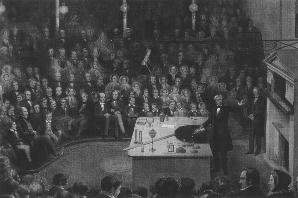
Many others objected to the theory of man's evolution on religious grounds. In England, the Anglican clergy rejected the idea of evolution of humans, and debated openly with supporters of Darwinism. Samuel Wilberforce, a country clergyman who rose to become the Bishop of Oxford, considered himself highly liberal on matters of personal conduct, but a High Church conservative with respect to theological matters. In 1860, he participated in a meeting of the British Association at Oxford University, where he spoke against Darwin's theory of evolution. Darwin himself was not present, but Thomas Henry Huxley took on the task of answering Wilberforce's attack. The general consensus was that Huxley had done better in defending his position than Wilberforce had in defending his; the participants were not antagonistic, and in fact they all went off to dinner together after the debate.
Read Samuel Wilberforce's comments On Darwin's Origin of Species, originally written and printed in the Quarterly Review.
- What distinctions does Wilberforce make between science and revelation?
- What key problems does he bring up as unanswered by the theory? (Darwin admitted that Wilberforce had determined the major weaknesses of his theory).
- Have any of Wilberforce's objections been addressed by more recent discoveries?
St. George Mivart
Wilberforce's efforts have become famous largely because of interpretations over the debate in the last century; he himself did not consider the debate crucial and he spent most of his efforts in other areas, encouraging his parishioners to become more active in the social justice issues of his time. The chief British opponent to Darwinism was St. George Jackson Mivart, a prominent Catholic natural philosopher whom Darwin acknowledged as a "distinguished biologist". Mivart was born in London, and raised as an evangelical Christian, but converted to Catholicism while in college. Barred from attending Oxford because of his Catholicism, Mivart studied law but eventually became the lecturer in Zoology at a London Medical school, where he did research into the skeletons of primates. Mivart's opinions in later life brought him into controversy with his Church, but his "Genesis of Species" article was considered a crucial counter-argument to Darwin's position, so much so that in later editions of the Origin of Species, Darwin had to address the specific points Mivart raised.
Read Mivart's Review on the Genesis of the Species, printed in 1871.
- What does Mivart quote from St. Augustine to conclude (at first) that Christian thinkers might accept an evolutionary explanation for the diversity of life on earth?
- Does Mivart find any theological objections to evolution? Are there any limitations that he places on the idea as proposed by Darwin?
Study/Discussion Questions:
- What major objections did scientists raise to evolution as proposed by Darwin?
- What major objections did theologians have to his theories?
Further Study/On Your Own
- There is a very good review of the Wilberforce-Huxley debate from an Oxford University site, which discusses some of the stories that have grown up around what actually happened.
© 2005 - 2026 This course is offered through Scholars Online, a non-profit organization supporting classical Christian education through online courses. Permission to copy course content (lessons and labs) for personal study is granted to students currently or formerly enrolled in the course through Scholars Online. Reproduction for any other purpose, without the express written consent of the author, is prohibited.