Natural Science - Year II
Unit 43: Darwin and Natural Selection

Science Web Assignment for Unit 43
| This Unit's | Homework Page | History Lecture | Science Lecture | Lab | Parents' Notes |
For 2026: Please note that units are considered "under revision" until two weeks before the class date, and page content, web assignments, and exercises may change before that deadline.
Science Lecture for Unit 43: The Case Made for Evolution Theory
For Class
- Topic area: Evolution and biology
- Terms and concepts to know: Natural Selection, fossil
- See historical period(s): 19th Century
Outline/Summary
Modern Theories of Evolution
Modern evolution draws much of its evidence from genetics, a theory and set of evidence which Darwin did not know about. We will discuss genetics in another unit, when we study the work of Gregor Mendel.
Evidence for evolution used by biologists
Biologists draw on evidence from many different sources in order to establish the relationships of different species to common ancestors according to evolutionary theories.
- Fossils are animal and plant parts that have been preserved in rocks and minerals. They are are found all over the world, in all habitats and at most depths. Because organic material usually disintegrates, most fossil conversions are of the "hard" parts of animals. Geologists use both radioactive mineral dating (and usually try to test for several different ones in a given sample, in order to establish the range of time periods more actively) as well as the location of the sample in a particular starta or type of material. By comparing the information for many different fossil remains, geologists have producd a set of standards for interpreting fossil evidence that is consistent across most fossils.
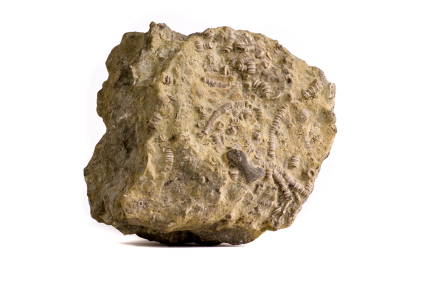
This example of a fossil shows how sea plants were trapped in sedimentary layers and, over time, 'fossilized' into rock forms.
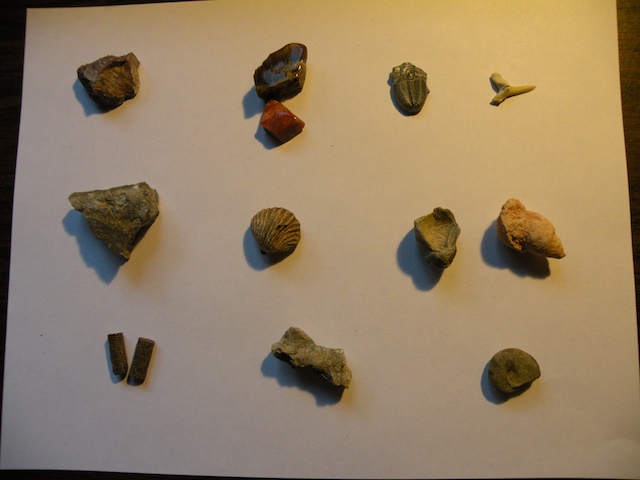
A set of fossils from Utah. Any theory of the origins of life must account for all fossils and their apparent ages.
- Comparative anatomy is the study of structural forms. Homologous structures are similar basic structures with different functions, such as human arms and bat's wings. Analogous structures are different structures with similar functions, such as the lungs of mammals and the air tubes of insects. Species with similar homologous structures are considered more closely related than species with similar analogous strucutres. Vestigial organs are body parts that have no current, discernable function, but which perhaps once supplied an important function to an organism's ancestors. Wisdom teeth and the appendix are examples of vestigial structures in humans. Their existence puzzled Darwin greatly when he first undertook his researches, because he could not understand why God would have put something useless in one of His creatures.
- Embryological development is also used to determine evolutionary relationships. Animals with similar structures in early fetal development are considered more closely related than animals that do not share similar structures at that stage. The idea is that at the basic level, the animals shared a common ancestor, hence the common features. As each species developed new characteristics that become evident as the animal develops and cells differentiate into their specialized functions, the common features may be submerged in new features or lost entirely as no longer useful for survival.
- Biogeography assumes that each species originated only once--that a specific series is a rare, one-time event. Using this premise, it is possible to look at the fossil evidence and current distribution of animals and plants and determine a center of origin for a given species, from which it spread to its current habitats. This pattern allows us to account for the fact that some animals that have excellent survival characteristics for a given climate and environment are not found in all the places where that environment exists. For example, lions are found only in the savannahs of Africa, and not in the very similar pampas of Argentina, so from biogeography, we would conclude that lions originated in Africa and were unable to cross the ocean to South America.
- Genetic similarities and divergence also provide a biologist with evidence for possible evolutionary relationships. We will talk about some of this evidence when we discuss cells and DNA.
Populations and evolution
Modern evolutionists are careful to emphasize that they discuss the evolution of populations, not individuals. A population is any well-defined set of organisms. One of the most common populations to consider is the species, which is defined in biology as any group of organisms that will breed and produce fertile offspring under natural conditions. In some ways, this is an artifical distinction: animals which may be able to produce in the lab might not meet to produce in nature, because they live in different areas.
In most cases, interbreeding is what produces the range of characteristics available to each generation of the population. If the species is isolated by its mating practices and opportunities, no variations in characteristics will be introduced from outside organisms, although new ones may be created by mutation. As the population becomes adapted to its environment, the frequency of occurance (or the number of individuals with a particular characteristic) shifts. If the shift continues over several generations with a measurable or significant change in the frequency, biologists say that microevolution is occuring. Note that microevolutionary changes are litmited to within species; a single microevolutionary event does not result in the emergence of new species.
Biologists use a mathematical relationship called the Hardy-Weinberg principle to determine whether microevolution is occuring. If successive generations have a distribution of characteristics that follow this principle, then the biologists are reasonably certain the following conditions apply:
- All matings are random.
- No mutations are occuring.
- The population is large, so that statistical deviations are muted.
- No migrations are occuring, so no new types of characteristics are being added
- No mechanisms for natural selection are occuring.
Generally, studies of populations show some deviation is occuring in the population.
Factors in microevolution
Five different causes are usually listed as sources of microevolutionary change. Notice that some factors increase genetic diversity while other factors reduce it.
- Genetic drift is the loss of traits because the frequency of carriers drops so low that a time comes when the last carrier is killed before it can reproduce. Genetic drift always reduces variation in the gene pool. Genetic drift occurs in bottleneck events, when a catastrophe such as disease or loss of habitat severely reduces a population. There is evidence that this happened to the cheetah population in the past, since modern cheetahs in the wild share nearly identical traits.
- Gene flow is the introduction of new genetic material into a previously isolated population as a result of the migration of individuals into the population. Gene flow increases the genetic variation of the population. The most dramatic example of gene flow is the modern migration of previously isolated human populations all over the world.
- Mutations are permanent, unpredicatable changes in DNA sequences. Only changes that occur in reproductive cells will be passed on to offspring. Most such mutations are harmful.
- Nonrandom mating occurs when individual organisms selectively breed with only a portion of the population. Since partners are not randomly chosen, this process decreases genetic variation. Exposing specimens such as fruitflies to radiation produces mutations that can drastically alter their appearance. However, only when the mutation occurs in specific cells can it be inherited by offspring and become part of the population's bank of traits.
- Natural selection is the non-random preservation over generations of particular traits that increase survivability. Natural selection generally decreases genetic variation, especially if the population is small enough that all the individuals carrying a particular trait can be killed off in a single event.
- Stabilizing selection favors organisms which do not express the extremes for a particular trait. For example, human birth weights remain within a particular range; babies with high weights or low weights frequently do no survive to adulthood.
- Direction selection favors one extreme over the other. Bacteria which are resistent to penicillin are more likely to survive than bacteria which are less resistent; over time, the entire population shifts to more resistent bacteria.
- Diversifying selection favors both extremes over the middle. Preditors often go after the most common form of a particular trait, recognizing that trait as a sign of good eating, while ignoring similar individuals of the species which express the trait differently.
Macroevolution
The more controversial aspects of evolution involve the theories of macroevolution that are used to explain changes in an entire species.
An existing species can die out or become extinct; such events are usually associated with a catastrophe that suddenly or gradually destroys the species habitat. We are constantly being warned that the trend of global warming, or the destruction of tropical rain forests or our own old growth forests will result in the loss of many species of insects, plants, and animals. Many biologists think that the fossil record shows several periods of mass extinction, such as the abrupt disappearance of the dinosaurs, dated to about 65 million years ago.
A new species (a population which can no longer mate with pre-existing species) may emerge from existing species. The sudden appearance of fossils with particular traits in later rock strata is used as evidence of the appearance of a new species. One of the biggest challenges to current evolution theory is that no "intermediate forms" exist for fossils which appear related except for one or two major characteristics.
The emergence of new species (using the above definition) is actually a relatively common occurance, particularly with hybrid plants, when the offspring of the hybrids cannot cross-pollinate with the parent plants or their normal offspring any longer. It also occurs in some animal forms, although rarely because of the more complex structures of animals.
One of the criteria for a successful "new species" is its ability to reproduce healthy offspring. Hybrid plants can reproduce and often become staples of new food, such as the triticale wheat we use in bread. In contrast, as an example of an unsuccessful mating, consider the mule. Mules are the hybrid offspring of horses and donkeys, but are sterile and so not considered a true species.
Study/Discussion Questions
- What are the differences between random and nonrandom factors in evolution?
- What is the difference between microevolution and macroevolution? What kind of evidence is used to support each theory?
Further Study On your Own (Optional)
See if you can determine a mutation that favors the survival of the bunnies in a world of limited food. Which mutation favors the survival of the wolves?
© 2005 - 2026 This course is offered through Scholars Online, a non-profit organization supporting classical Christian education through online courses. Permission to copy course content (lessons and labs) for personal study is granted to students currently or formerly enrolled in the course through Scholars Online. Reproduction for any other purpose, without the express written consent of the author, is prohibited.