Natural Science - Year I
Unit 23: Vesalius and Physiology

History Weblecture for Unit 23
| This Unit's | Homework Page | History Lecture | Science Lecture | Lab | Parents' Notes |
For 2026: Please note that units are considered "under revision" until two weeks before the class date, and page content, web assignments, and exercises may change before that deadline.
History Lecture for Unit 23: Andreas Vesalius and Anatomy
For Class
- Period: 1400 ce to 1700 ce
For the interactive timelines, click on an image to bring it into focus and read notes.
Click on the icon to bring up the timeline in a separate browser window. You can then resize the window to make it easier to read the information.
Click here: Timeline PDF to bring up the timeline as a PDF document. You can then click on the individual events to see more information if you want. Exploring this version of the timeline is optional!
- Geographic Location: Western Europe
- People to know: Galen, Avicenna, Charles V, Andreas Vesalius
- See science topics: Human Anatomy II
Lecture outline:
The Revolution in Biology
Leondardo's work was limited because he didn't publish his observations. Few people knew what he had accomplished in establishing new ways of transmitting information. In the generation following Leonardo, though, there was a revolution in biology, especially human medicine, driven in part by a scholar who not only shared Leonardo's passion for using accurate drawings to convey information, but who also had the desire and self-discipline to see a project through to completion.
Andreas Vesalius
Andreas Vesalius was born in 1514 in Brussels. Grandson of the Emperor Maximillian's royal physician, Everard van Wesel, Vesalius studied Greek, Latin and the liberal arts at the University of Leuven, and determined to find a career in the service of a powerful patron by dint of hard work. To this end, he chose a medical career and enrolled in the medical school at the University of Paris.
At the time, the primary source of medical knowledge were the works of Avicenna and Galen. Claudius Galen, like Ptolemy, was a Hellenist of the mid-second century after Christ. He was a native of Pergamum in Asia Minor, and worked as a surgeon treating gladiators in the arena of his home town. He developed innovative techniques, some of which he recorded in his On Anatomical Procedures (not all of which survived into the Middle Ages). His reputation grew, and he eventually moved to Rome and served as court physician to Marcus Aurelius around 162 ce. He performed extensive dissections on Barbary apes, and applied what he observed in ape anatomy to human anatomy in his On the Use of the Parts of the Human Body. His works influenced Avicenna and other Arab medical authorities, and were part of the regular curriculum of studies in medicine at medieval universities.
Vesalius was impressed by the level of research Galen had done, and pursued his own studies of human anatomy. After completing his thesis work at Leuven (where he had been forced to return by the outbreak of war in France), he moved to Italy to continue his studies, and was offered the chair in Surgery and Anatomy at Padua. Contrary to the prevailing custom, Vesalius performed dissections himself as he lectured (rather than having untrained assistants do it).
Vesalius published the results of his studies in 1543 in a textbook of human anatomy called The Seven Books on the Structure of the Human body (De humani corporis fabrica libri septem). His efforts finally brought him the position he sought, an appointment as the regular physician to the household of Charles V, the Holy Roman emperor. He was only 27 years old.
The Vesalius Project at Northwestern University created an annotated translation of the De Humani Corpris Fabrica. Click on the small triangle next to "Book One", and read Chapter One on the Nature, Use, and Diversity of Bone.
[1 LONG page.]
- What type of matter does Vesalius think bones are made from?
- What are the main uses of different types of bone?
- How is cartilage different from bone?
- What observations does Vesalius make that show he has examined human bones?
Vesalius had noticed discrepancies between Galen's descriptions and the actual placement and structure of human organs. In his textbook, he dares to openly criticize the prevailing texts of Galen, Hippocrates, and Avicenna, and was able to show that Galen's descriptions were more applicable to pigs and monkeys than to humans.
Read this brief excerpt from the De fabricis on Vesalius' disagreement with Galen. The term articulation refers markings or evidence that show two joined areas are really different bones. Synarthrosis deals with bones that are sutured together into an immovable joint, like the bones of the skull. Harmonia sutures involve two smooth surfaces joined together; gomphosis involves one bone set inside another, like the teeth into the jawbone. Diathrosis describes. bones that come together in movable joints, like the shoulders, elbows, and knees.
[1 pages.]
- What are the key points of disagreement that Vesalius raises?
- On what evidence does Vesalius base his counter-argument?
Vesalius' new position gave his book more publicity and authority, and it was widely read. However, even his high position in the court of the Holy Roman Emperor could not shield Vesalius completely from attacks by those in more traditional schools of medical education, especially where dissection of corpses was still considered illegal and immoral. Vesalius undertook a pilgrimage to the Holy Land, perhaps partly to convince his critiques that he was still a loyal son of the Church. Tragically, he died on the way home.
Unlike Leonardo, Vesalius' influence was immediate and permanent. The publication of the Fabrica opened a era of criticism of Galen and the Arab commentators, and inspired new research into the function of the different organisms of the human body.
Medical Illustrations
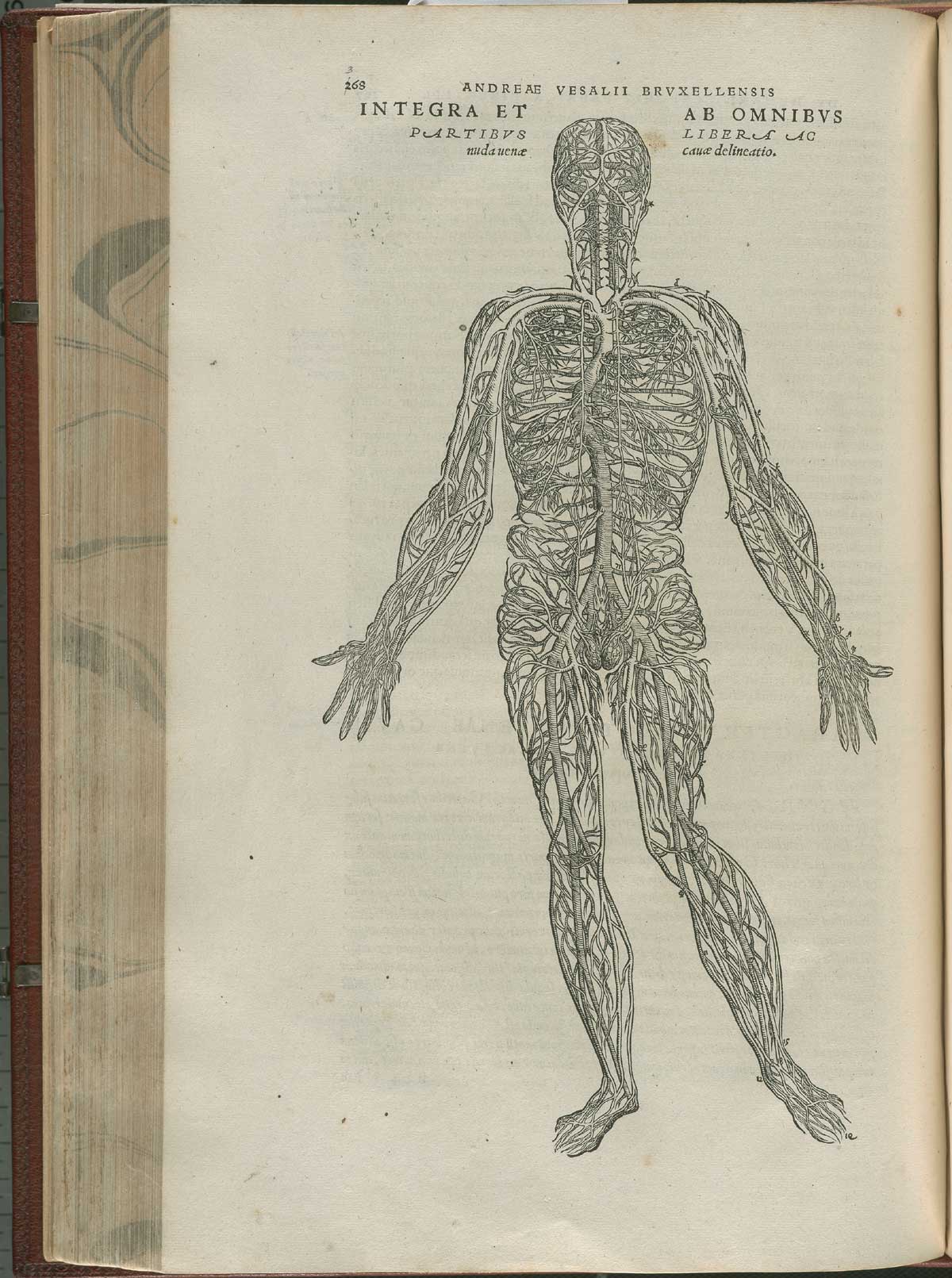
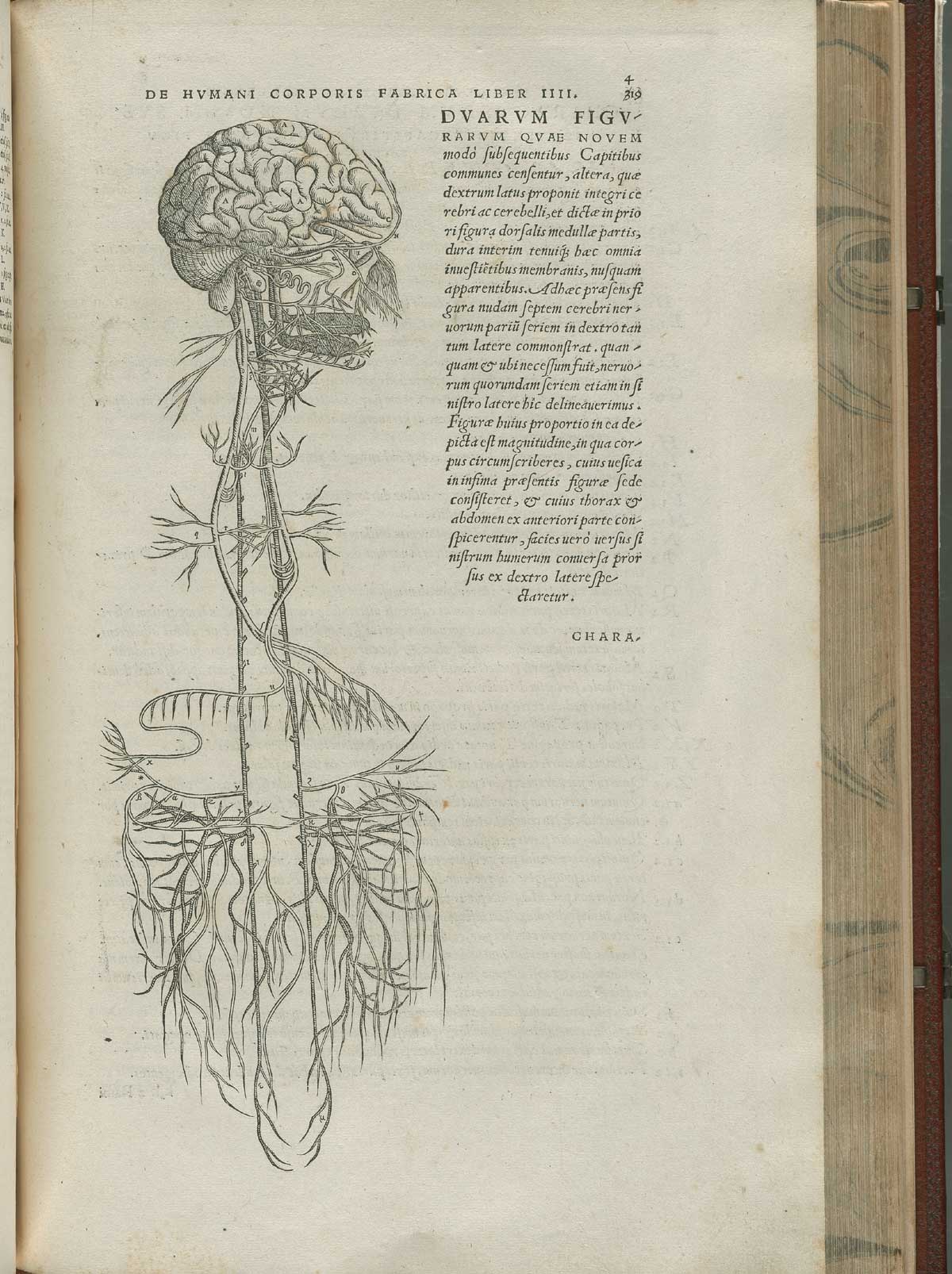
Perhaps even more important than his specific anatomical discoveries, however, was his use of drawings. His detailed diagrams and cutaway drawings established a new art form, scientific illustration, which spread from human anatomy into general biology and then into mechanics and the other scientific fields.
Study these drawings by Vesalius:
- A woodcut of a whole human body, showing muscle structure
- cutaway showing circulation system
- cutaway showing the nervous system
Consider these questions as you study the woodcuts:
- How does Vesalius rely on proper proportions to show relationships between the different body parts?
- How does Vesalius use cutaways to show layers?
- How does Vesalius tie verbal descriptions to particular body parts?
- How does the use of overlays or popups help the reader understand the location and relationships of the different body organs? About his popup drawings, Vesalius wrote:
We wish to advise those who obtain unprepared copies, and put them together by their own efforts and industry, on the method of cutting each from the superfluous paper and pasting them on, and then of coloring them according to their ability and desire. In order to provide strength, it will be useful to glue a piece of parchment to the back of the entire sheet so that it may not in vain be divided into as many pieces as there are figures comprising it.
Study/Discussion Questions:
- How does a cultural rule (as opposed to scientific principle) like not performing dissections on humans affect medical research? What ethical or religious issues in modern medicine affect current research?
- How would the Emperor's patronage help or hinder Vesalius' influence in Europe?
Further Study/On Your Own
- The Vesalius project at De Humani Corporis Fabricis has finally translated the entire work in a web-accessible critical edition. You can access subsequent chapters using the left-side navigation grid.
© 2005 - 2026 This course is offered through Scholars Online, a non-profit organization supporting classical Christian education through online courses. Permission to copy course content (lessons and labs) for personal study is granted to students currently or formerly enrolled in the course through Scholars Online. Reproduction for any other purpose, without the express written consent of the author, is prohibited.