Natural Science - Year I
Unit 20: Arab Science

History Weblecture for Unit 20
| This Unit's | Homework Page | History Lecture | Science Lecture | Lab | Parents' Notes |
For 2026: Please note that units are considered "under revision" until two weeks before the class date, and page content, web assignments, and exercises may change before that deadline.
History Lecture for Unit 20 History: Arab Science
For Class
- Period: 50 ce to 500 ce
For the interactive timelines, click on an image to bring it into focus and read notes.
Click on the icon to bring up the timeline in a separate browser window. You can then resize the window to make it easier to read the information.
Click here: Timeline PDF to bring up the timeline as a PDF document. You can then click on the individual events to see more information if you want. Exploring this version of the timeline is optional!
- Geographic Location: Middle East, Northern Africa, Spain, Sicily
- People to know: John Philoponus,
- See science topics: Optics
Lecture outline:
Transmission of Classical Knowledge
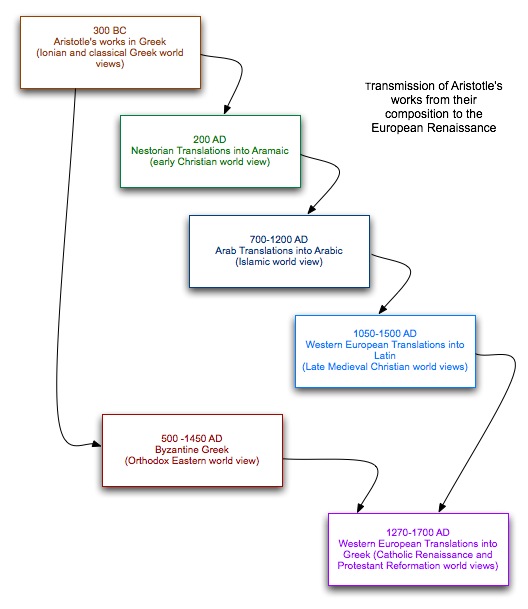
With the fall of the Roman Empire, the knowledge of the Greek language and Greek classical thought declined in western Europe to the point that no Greek manuscripts of the works of Aristotle, Plato, Ptolemy, or any of the other major Greek writers survived in a complete form. Plato's ideas persisted by reference in Augustine and Boethius' works on philosophy or theology, but often such references were incomplete, so that it was impossible to construct the original theory or concept. In the eastern Mediterranean, however, the works of Aristotle and Plato were preserved through a sequence of translations from one language to another as the dominant culture changed. It is important to remember that each translation was made by a different group with a different world view.
Byzantine Science
While the Roman empire was declining in western Europe, the eastern capital flourished, drawing scholars and philosophers from northern Africa to the south and Persia to the east. The Academy of Plato continued to teach and preserve classical Greek thought. Among its more famous teachers was Proclus Diadochus, a neo-Platonist, who wrote commentaries on Euclid, Hipparchus, and Ptolemy. He showed how Hero's water clock could be used to time the motions of the planets, sun, and moon. Proclus suggested a plenary explanation of the cosmos, in which the sphere bearing the moon reached to the sphere bearing Mercury, and Mercury's sphere extended to that of Venus, and so on through all the planetary spheres, so that all of space was filled.
A generation after Proclus, a Christian neo-Platonist wrote a number of works under the name of Dionysius the Areopagite. Since this was the name associated with the Greek citizen of Athens converted by St. Paul, his works came to have nearly apostolic authority, even though he lived at least four centuries later, and so had a great influence throughout the Middle Ages, even after people realized that the fifth century philosopher and the New Testament convert were not the same. To distinguish them, the fifth century philosopher became known as pseudo-Dionysius. While his writings derive primarily from the Jewish and Christian scriptures, he also drew heavily on Gregory of Nyssa, Plotinus, Iamblichus, and Prochlus. Several of his works center on the idea of a celestial hierarchy mapping the divisions of the heavens to the nine ranks of angels: seraphim, cherubim, thrones, dominations, virtues, powers, principalities, archangels, and angels. Each rank provided protection and transmitted the motion of the Prime Mover to the spheres below it.
In 529 ce, when the Emperor Justinian ordered its closure because of its pagan concentration, its remaining teachers fled eastward to Persia or south to Alexandria. It was in Alexandria that the philosopher John Philoponus lived and worked. Philoponus was highly critical of Aristotle's cosmological models and his explanations of motion, and debated Aristotle's claim that the world was eternal with the pagan philosopher Simplicius. A millenium before Galileo, he proposed dropping two balls of different weights to prove that weight had no influence on the acceleration of a falling body and anticipated the modern concepts of uniform acceleration and inertia. He made his own astronomical observations using an astrolabe. He offered the different colors of the stars as evidence that celestial matter was not uniform, but differed in composition, and changed, and was therefore not different from the corruptible matter that composed the earth and its inhabitants.
With Philoponus' death, scientific pursuits in Byzantium took second place to theological debates, and advances in science were few and far between.
Arabic Science in the Islamic World
| Scientist | Accomplishments |
| Jabir ibn Hayyan ca. 720-815 Geber | A medical doctor who wrote prolifically in many fields but most often about chemistry (alchemy) and techniques for extracting substances from compounds using methods like distillation, sublimation, and evaporation. he was a practical chemist, looking for ways to forge steel, dye cloth, tan leather, letter in gold and make paints of different colors. His books on chemistry were translated into Latin and influenced modern chemistry, providing instructions in fundamental methods of experimental chemistry. |
| al-Khwarizmi 800-850 Algorismus | Introduced the Hindu positional system of numbers, including use of the zero; wrote Al-jabr w'al Muqabala (the Algebra) which contained analytical and geometric methods for solving linear and quadratic equations. |
| Hunain ibn Ishaq 809-873 Johannitius | A Nestorian Christian, Hunain fostered a group of scholars who translated many works, including many medical works by Galen, Euclid's Elements of Geometry, Aristotle's Categories and Physics, Plato's Timaeus, and Dioscorides' Materia Medica from Greek into Arabic. and Syriac. He was a prominent physician, and a leading authority in ophthalmology. |
| al-Farghani 820-861 Alfarganus | A distinguished astronomer, al-Farghani used the Ptolemaic system to determine the distances to planets and wrote a major treatise on astronomy, the Kitab fi al-Harakat, which in its Latin translation greatly influenced Europe. |
| al-Battani 858-929 Albategnius | al-Battani's Kitab al-Zij covers the whole of astronomy and the mathematics required to determine the motions of the sun, moon, and planets based on Ptolemaic theories. He catalogued nearly 500 stars and and refined calculations for the length of the year. |
| al-Farabi 870-950 | Known as the Second Master after Aristotle to many Arabs, he wrote works on metaphysics, logics, and musicians. He was considered the founder of neo-Platonism in Arab culture. A hierarchy of being extends from the Divine Being or First to the Second Being (or First Intellect), both immaterial like God. Each being generates another being, through all the ranks of stars and planets. |
| al-Biruni 973-1048 | A student of Abu Nasr Mansur in what is now Uzbekistan, al-Biruni was forced to leave his homeland and flee to Afghanistan, where he became acquainted with the astronomer al-Khujandi. He created an encyclopaedia on astronomy called the Chronology, which contained many observations he had made himself. He also wrote on timekeeping, geodesy, geography, algebra, geometry, conic sections, trigonometry, philosophy, and physics. |
| Ibn Yunis d. 1009 | Used the observatory of al-Hakim to improve observations and predict conjunctions and eclipses. |
| ibn al-Haytham 965-1039 Alhazen | Alhazen's area of expertise was optics, on which he wrote nearly a hundred works, half of which have survived. His most important work, Kitab al-Manazir was translated into Latin in 1270 as the Opticae thesaurus Alhazeni and influenced Europe for several centuries. Alhazen correctly explained that light is reflected into the eye. He did not understand how lenses worked, so he was unable to explain exactly what happened then. Alhazen wrote on mathematics and astronomy as well. |
| Ibn Sina 980-1037 Avicenna | Ibn Sina was a child prodigy who by the age of 16 had mastered the Qur'an, Arab classics, Jurisprudence, Philosophy, Euclid, and the Almagest. He died at the relatively young age of 58, having composed somewhere between 50 and 100 works in philosophy, medicine, theology, geometry, and astronomy. |
| Ibn Rashd 1125-1198 Averroes | Known as the Great Commentator to the European West, ibn Rushd believed there was no incompatibility between religion and philosophy when both were understood in their proper relationship. His works suggested to Thomas Aquinas the possibility of reconciling Christianity with the classical Aristotelian philosophy that fascinated Aquinas. |
Read what Averroes has to say about the harmony of religion and philosophy at the Muslim Philosophy site.
[1 page.]
- What ideas does Averroes share with Aristotle?
- How does Averroes justify the study of philosophy and mathematics?
- How are his reasons similar or different from those of the early Christian Fathers?
Study/Discussion Questions:
- What were some of the major criticisms leveled against Aristotle by Philoponus?
- How did Arab philosophers influence the Latin West?
Further Study/On Your Own
- Check out the Lapham's Quarterly article on How Early Islamic Science Advanced Medicine.
© 2005 - 2026 This course is offered through Scholars Online, a non-profit organization supporting classical Christian education through online courses. Permission to copy course content (lessons and labs) for personal study is granted to students currently or formerly enrolled in the course through Scholars Online. Reproduction for any other purpose, without the express written consent of the author, is prohibited.