Natural Science - Year I
Unit 15: Roman Engineering

History Weblecture for Unit 15
| This Unit's | Homework Page | History Lecture | Science Lecture | Lab | Parents' Notes |
For 2026: Please note that units are considered "under revision" until two weeks before the class date, and page content, web assignments, and exercises may change before that deadline.
History Lecture for Unit 15: Roman Engineering
For Class
- Period: 500 bce - 400 ce
For the interactive timelines, click on an image to bring it into focus and read notes.
Click on the icon to bring up the timeline in a separate browser window. You can then resize the window to make it easier to read the information.
Click here: Timeline PDF to bring up the timeline as a PDF document. You can then click on the individual events to see more information if you want. Exploring this version of the timeline is optional!
- Geographic Location: Italy
- People to know: Vitruvius (ca. 30 bce)
- See science topics: Engineering and City Design
Lecture outline:
Roman Engineering
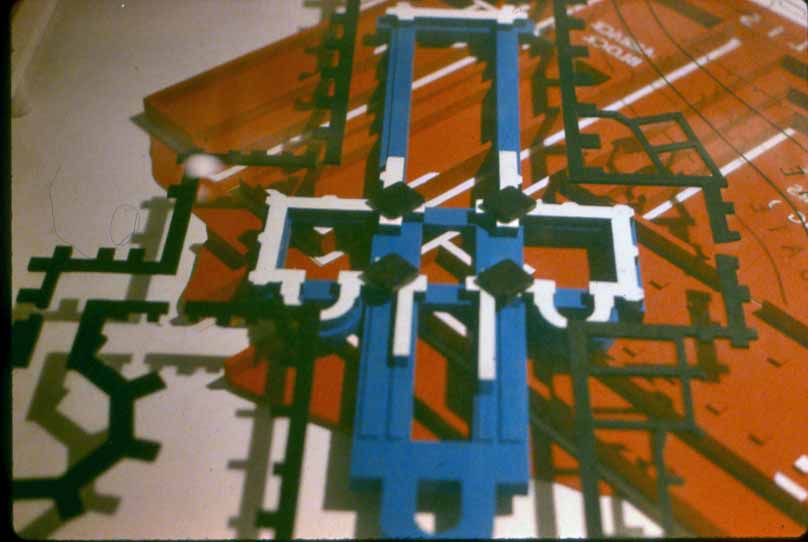
©1986 Christe Ann McMenomy
In the late 1960s, the city of York in northern England began an immense engineering project beneath the central tower of York Minster, its medieval cathedral originally built between 1280 and 1472. The enormous weight of the central tower was compressing the ground on which its stone pillars stood and threatening eventual collapse of the structure. Civil engineers planned to put concrete "shoes" around the base of the stone pillars and send steel rebar through the stone and concrete to distribute the weight of the pillars across more surface area.
During the excavation below the building's crypt, the engineers discovered not only the foundations of the Norman church built around 1075 (blue) that had predated the Gothic cathedral (black), but also the Saxon church (white) built in 741 after fire destroyed the Northumbrian edifice originally completed around 630 ce, and the ruins of the Roman encampment of Eboricum (red area), built by Constantius, the father of Constantine the Great, while he was governor of northern Britain in 300 ce. Despite the delay caused by the need to perform an archaeological dig during the construction, the repairs to the tower stone pillars were completed in 1972.

Lightning struck the wooden roof of the South Transept of the Minster in 1984, and the entire roof burned, collapsing into the transept. City fire units poured thousands of gallons of water onto the Minster in an effort to put the Naturafire out before the entire building was destroyed. When it was safe to enter, the staff and fire chief examined the crypt under the building, expecting to find it flooded. But there was no standing water anywhere. The drains built by the Romans for their encampment 2000 years before were still functioning, and had carried all the water back to the River Ouse.
Roman Bridges
In our last unit, we looked at how the Greeks addressed the problems of doing work, which always involves. moving things around. We also reviewed how we use modern machines made from simple machine components to achieve the same goals. Now we are going to look at statics, or static equilibrium, the study of how to balance all the forces acting on an object to keep it motionless (and standing up).
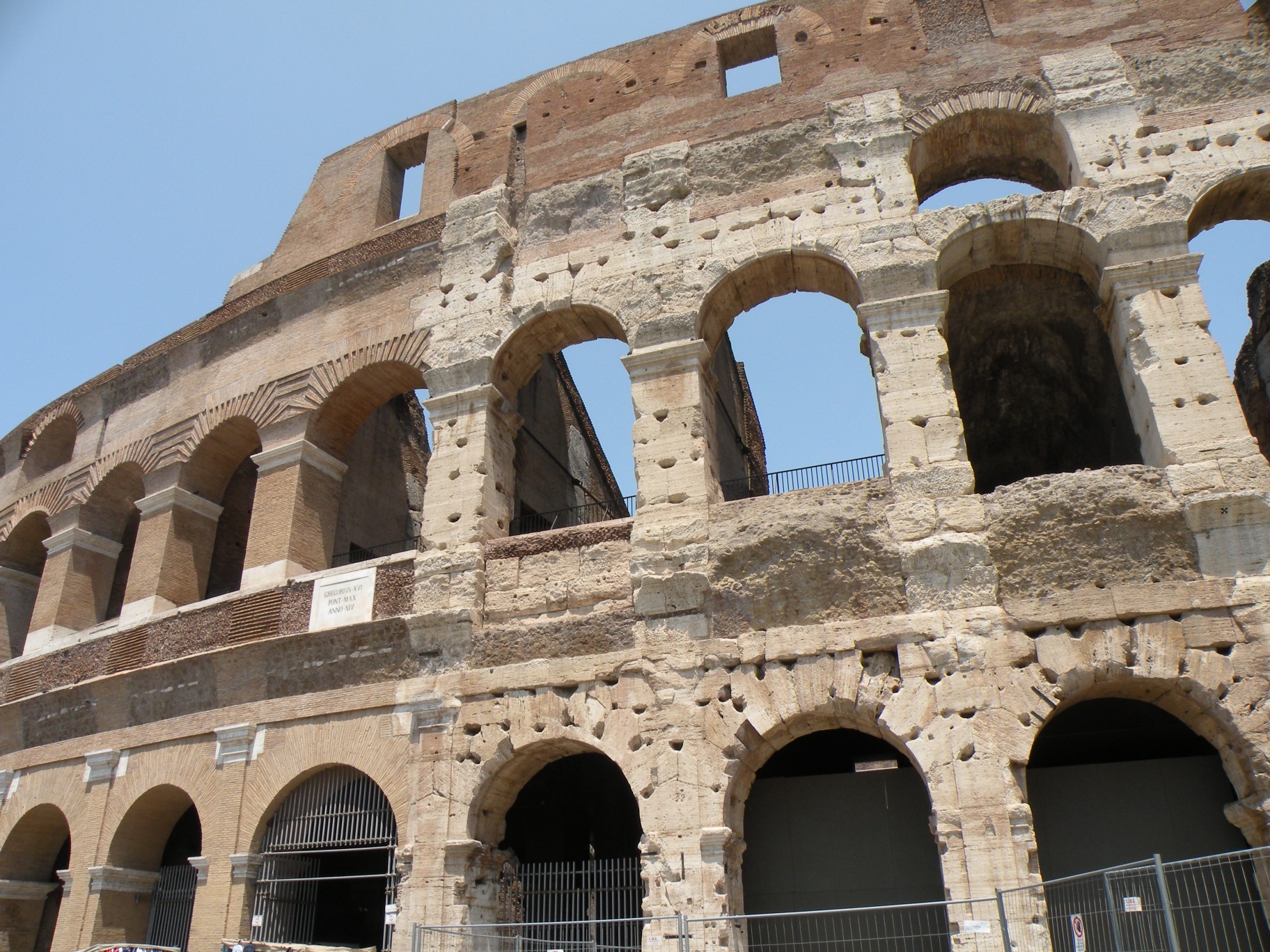
The Roman engineers successfully tackled construction of temples, basilica, fora, and other public buildings, roads and aqueducts, and entire cities, by mastering the basic principles of static equilibrium. Most of the structural forms they used were invented by earlier cultures. The keystone or corbel arch exists in bridges built in Mycenae in the fourteenth century B. C. (see Arkadio Bridge on the timeline). Babylonian, Greek, Egyptian, and Assyrian civilization all used the arch form, but primarily for underground structures, where the sides could be braced.
©2015 Christe McMenomy
Study the Arch diagram at Wikipedia. Notice the grey arrows showing the downward forces on the arch blocks. These forces are exerted by the weight of the wall above, and the arch blocks themselves. The force of this weight is transferred down, but also outward by the shape of the blocks. This arch must be braced from the side to retain its integrity.
The Romans learned how to brace the arch efficiently as part of a bridge or aqueduct or wall, where there would be lateral support along the entire structure. They also determined how to rotate the arch to form a dome.
We will concentrate on bridges and city planning, since a thorough study of all of the achievements of Roman engineering would take too long!
- Take enough time looking through the list of Roman bridges to get a sense of the both extent of practical influence of the Roman empire and their engineering accomplishments. In particular, examine the links and descriptions for the Pons Fabricius bridge and the Pont d'Aël. [the links will take you to Wikipedia articles on each bridge, which you should read.]
- Study the stones and keystone shape of the Roman Bridges, in particular pictures A55-A56-A57, which show the Severan Bridge (over Kâhta Creek in Turkey).
- Read about Roman concrete and why it was important, at the same site.
[1 page.]
- Read the brief introduction to Roman Architecture at History World.
[1 page.]
- Use the applet at NOVA's aqueduct site to construct a virtual bridge arch for an aqueduct. [Note: as of September, 2018, no major browser current release supports Java Applets or Shockwave any more. If you have an older browser, you may still be able to run this activity.]
As you read, think about these points:
- What is the major challenge in building a bridge or arch?
- How did the Romans solve this challenge? How do modern engineers solve it?
- Why did an aqueduct need to be stronger than a foot bridge?
- What is concrete?
- How did it enable the Romans to build arches and other spans?
- How did the Romans decorate with the materials that they used for building?
Roman Cities
Another form of modern engineering is called "systems engineering". This involves putting components together to accomplish some purpose, in such a way that the components complement one another and don't get in each others' way. The Romans were good at creating systems of government, organizing armies, and creating cities in which very large populations could survive. To do so, they needed to understand how to break the large group down into smaller units, understand how each contributes to the whole, and put them in a useful organization where each can both communicate with the others and do its own job well. We use many of the same ideas in putting together groups of people to form our institutions, build our cities, and even program our computers.
Much of what we know about Roman theories of architecture and city planning comes from the De architectura of Marcus Vitruvius Pollio. We don't know very much about Vitruvius' life, other than that he was a military expert and army engineer serving in Africa, Spain, southern France, and Asia Minor during the reign of Caesar Augustus, based on the battles and locations mentioned in his books.
Take a look at the English translation of the De architectura at the University of Chicago's Vitruvius site. Look through the chapter headings, and then read Chapter 1 of book V.
[2 pages.]
Consider these points as you read:
- What public buildings does Vitruvius describe?
- How does Vitruvius into consideration temperature, lighting, and the intended use of the building in determining the design?
Roman city planning begin with the fortified camps of the army, which were set up to allow a rapid exit to meet the enemy on the field, and strong defenses if the army was besieged.
Study the map of Timgad, a Roman city in Northern Africa. Consider these points as you read the notes on the sides and the labels on buildings in the city:
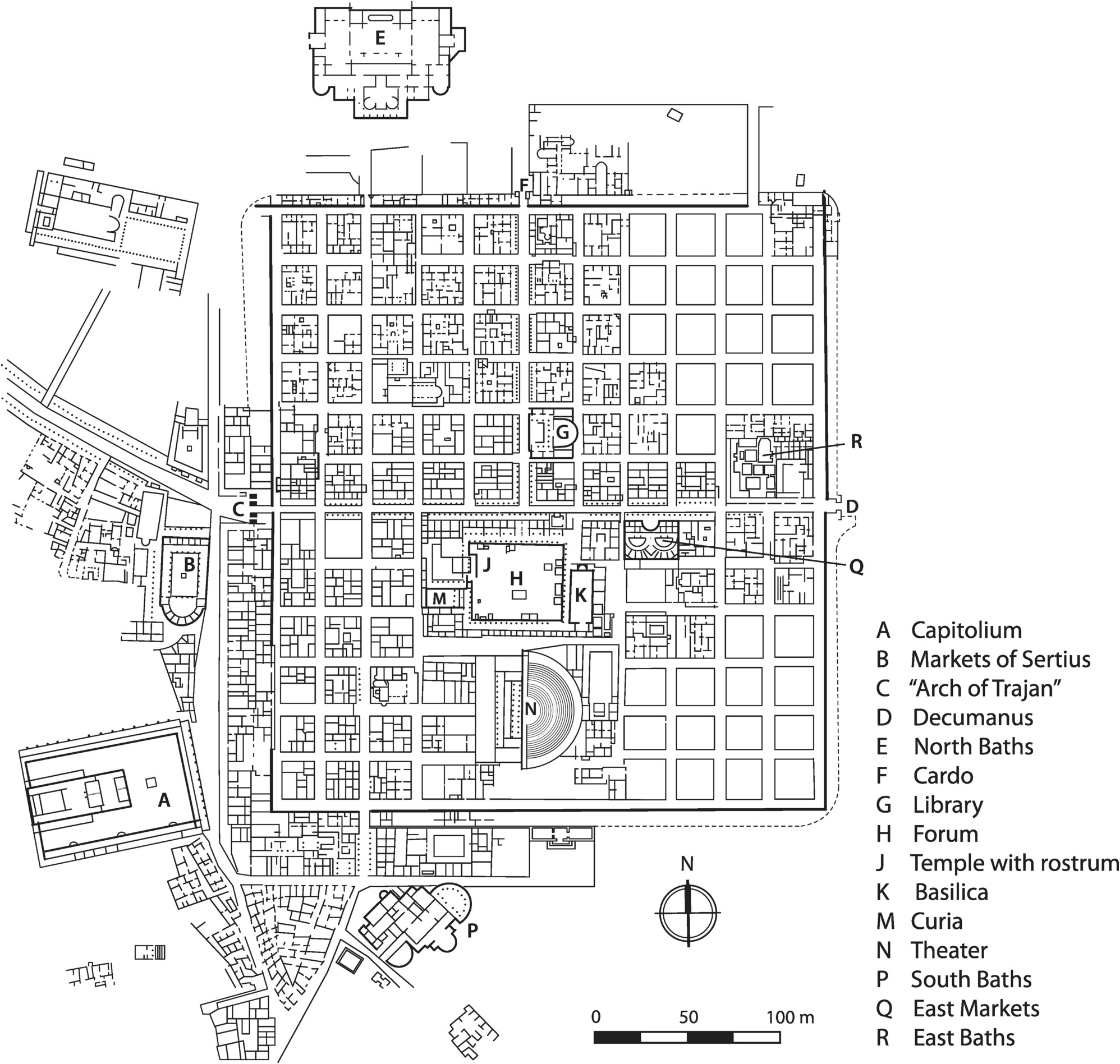
- What public buildings are part of the city?
- How are the streets laid out? How would this help people move easily around the city? Find their way?
- What are the cities defenses?
- What must exist inside the city walls for this city to survive a siege?
Study/Discussion Questions
- What kinds of problems did the Roman engineers need to solve?
- How did they chose materials to solve their problems?
- How did they organize shape and components to solve their problems?
- What conditions allowed the Romans to succeed in building large cities?
Further Study/On Your Own
- There is a wonderful article with pictures on Pons, (Bridges of Greece and Rome), originally written in 1875.
- A very detailed article at the University of Pennsylvania on Roman Colonial Planning uses the city of Corinth as an example.
© 2005 - 2026 This course is offered through Scholars Online, a non-profit organization supporting classical Christian education through online courses. Permission to copy course content (lessons and labs) for personal study is granted to students currently or formerly enrolled in the course through Scholars Online. Reproduction for any other purpose, without the express written consent of the author, is prohibited.